
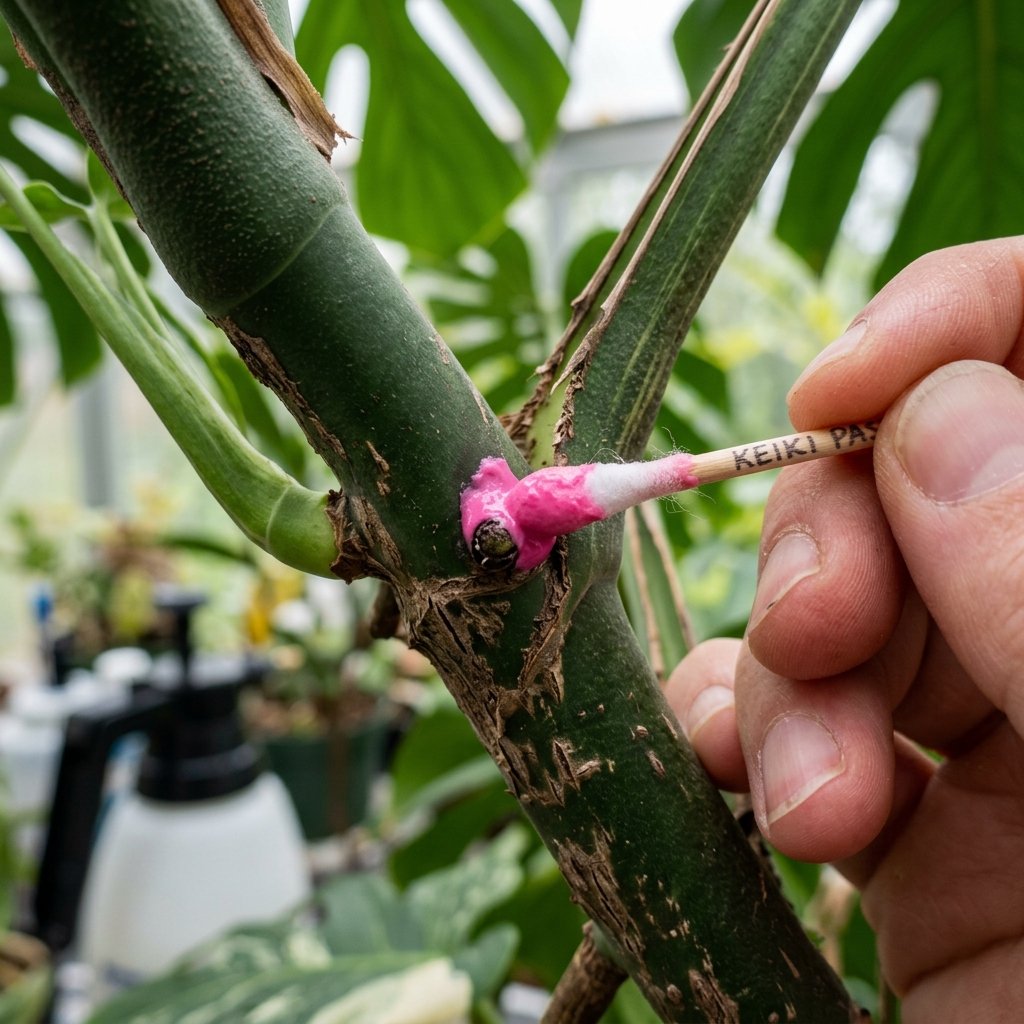

For decades, Keiki paste (a sticky, brightly colored hormonal ointment) was the best-kept secret of the hardcore Orchid community, used to force Phalaenopsis orchids to produce baby plants (“keikis”) on dead flower spikes. But in 2026, the Aroid community has hijacked it. Smearing Keiki paste on dormant Philodendron and Monstera nodes is the most viral propagation hack on the internet.
What Exactly is Keiki Paste?
Keiki paste is a lanolin-based ointment heavily concentrated with Cytokinin (specifically Benzylaminopurine or BAP). Cytokinins are plant hormones that aggressively promote cell division and shoot formation, overriding the plant’s natural dormancy signals.
When Should You Use It?
- The Empty Vine: If your pothos or Monstera dropped leaves at the base, leaving a long, ugly, bald stem.
- The Stubborn Wet-Stick: When you have a rare cutting (a node) sitting in moss for 6 months refusing to push a growth point.
- The Reverted Albo: Forcing a secondary axillary bud to activate below a reverted green node on a variegated plant.
The Right Way to Hack Nodes
If you slather Keiki paste haphazardly, you will deform your plant or exhaust its energy reserves. You must apply it with surgical precision.
- Locate the Axillary Bud: This is NOT the aerial root. Look closely at a node. Right above the prominent leaf scar, there is a tiny, slightly raised, crescent-shaped “eye”. This is the dormant growth point.
- Break the Callus: Take a sterilized needle and very, very gently scratch the surface of the “eye” to expose the fresh green tissue underneath.
- Apply a Micro-Dose: Take a toothpick, dip it in the Keiki paste, and apply a tiny dab (the size of a pinhead) directly onto the scratched eye.
The Warnings
Cytokinin essentially forces the plant into overdrive. If you activate 5 nodes on a single vine at once, the mother plant will not have enough root mass or energy to support them all. The new leaves will emerge heavily deformed, or the plant will rapidly cannibalize its older leaves to survive. Only activate ONE bud at a time per root system.
What’s Your Next Step?
You have successfully activated a dormant node. This demonstrates a superior level of control over your plant’s biology. Now, consider the efficiency of your entire collection’s ecosystem. Two critical variables remain unchecked.
- <
Frequently Asked Questions
What are the best conditions for this plant?
Most houseplants thrive in bright, indirect light with temperatures between 65-80F (18-27C). Ensure good drainage and water when the top inch of soil feels dry.
How often should I water?
Watering frequency depends on the plant species, pot size, and environment. A general rule is to check the soil moisture before watering. Overwatering is the most common cause of houseplant death.
What soil mix works best?
A well-draining mix of peat moss, perlite, and orchid bark works well for most tropical houseplants. Succulents prefer a grittier mix with more sand and perlite.
Quick Care Reference
Factor Requirement Notes Light Bright indirect Avoid direct afternoon sun Water When top inch dry Reduce in winter Humidity 50-70% Mist or use pebble tray Temperature 65-80F (18-27C) Avoid cold drafts Soil Well-draining mix Peat, perlite, bark Fertilizer Monthly (spring-summer) Half-strength balanced