
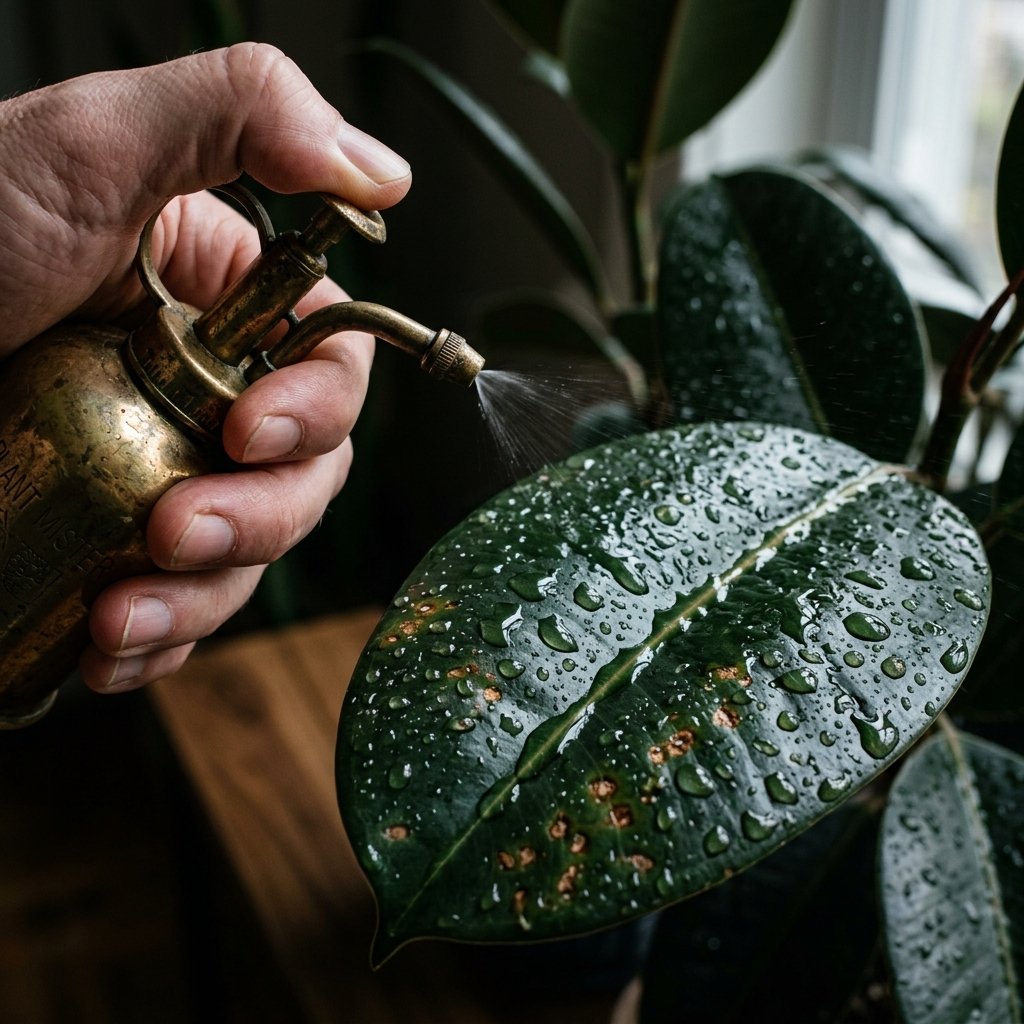

It is the most enduring, romanticized ritual in the houseplant community: waking up, grabbing a beautiful brass mister, and spraying water over your ferns and Monsteras to “increase humidity.” This advice has been printed on plant tags for fifty years. And scientifically speaking, it is completely, violently wrong.
The Science of Micro-Climates
Misting a plant increases the localized relative humidity for precisely 10 to 15 minutes. Once the water evaporates, the humidity in the room immediately drops back to its baseline. Unless you are standing in front of your plant misting it every 15 minutes for 24 hours a day, you are not altering its micro-climate in any meaningful way.
The Fungal Danger
- Liquid Water vs Vapor: Humidity is water vapor (gas). Misting is liquid water. Sitting liquid water is not humidity.
- The Spore Trigger: The vast majority of bacterial and fungal pathogens (like Rust and Powdery Mildew) require a drop of standing liquid water on a leaf surface for more than 4 hours to germinate.
Why Misting Kills Calatheas
People commonly mist Calatheas to prevent crispy edges. But Calatheas have tiny micro-hairs on their leaves. When you spray them, the water droplets get trapped in the microscopic hairs, acting as magnifying glasses under sunlight. This physically burns the cellular tissue, causing the exact brown spotting you were trying to prevent.
What Actually Works
If your environment is too dry, you have only three biologically effective options:
1. The Humidifier
The only way to raise the baseline ambient humidity of a room is to mechanically aerosolize gallons of water into the air via a high-output evaporative humidifier.
2. The Pebble Tray (Mildly Effective)
Placing your pot on a tray filled with pebbles and water (ensuring the pot itself does not touch the water). As the water slowly evaporates all day, it creates a very mild, sustained column of humidity directly around the foliage.
3. The Grouping Method
Plants transpire (sweat) water vapor out of their leaves. If you clump massive amounts of plants together in a tight circle, their collective transpiration creates a localized canopy of high humidity.
Conclusion
Put the mister away. Use it for wiping down dusty leaves with a microfiber cloth or spraying pest treatments, but never use it to “increase humidity.”
What’s Your Next Step?
You have now corrected a critical error in your plant care routine. This analysis indicates a high probability that other common practices may be inadvertently harming your plants. The next logical step is to evaluate your watering systems and water quality.
- <a href="https://plantsmag.com/the-self-watering-pot-trap-finding
Frequently Asked Questions
What are the best conditions for this plant?
Most houseplants thrive in bright, indirect light with temperatures between 65-80F (18-27C). Ensure good drainage and water when the top inch of soil feels dry.
How often should I water?
Watering frequency depends on the plant species, pot size, and environment. A general rule is to check the soil moisture before watering. Overwatering is the most common cause of houseplant death.
What soil mix works best?
A well-draining mix of peat moss, perlite, and orchid bark works well for most tropical houseplants. Succulents prefer a grittier mix with more sand and perlite.
Quick Care Reference
Factor Requirement Notes Light Bright indirect Avoid direct afternoon sun Water When top inch dry Reduce in winter Humidity 50-70% Mist or use pebble tray Temperature 65-80F (18-27C) Avoid cold drafts Soil Well-draining mix Peat, perlite, bark Fertilizer Monthly (spring-summer) Half-strength balanced