
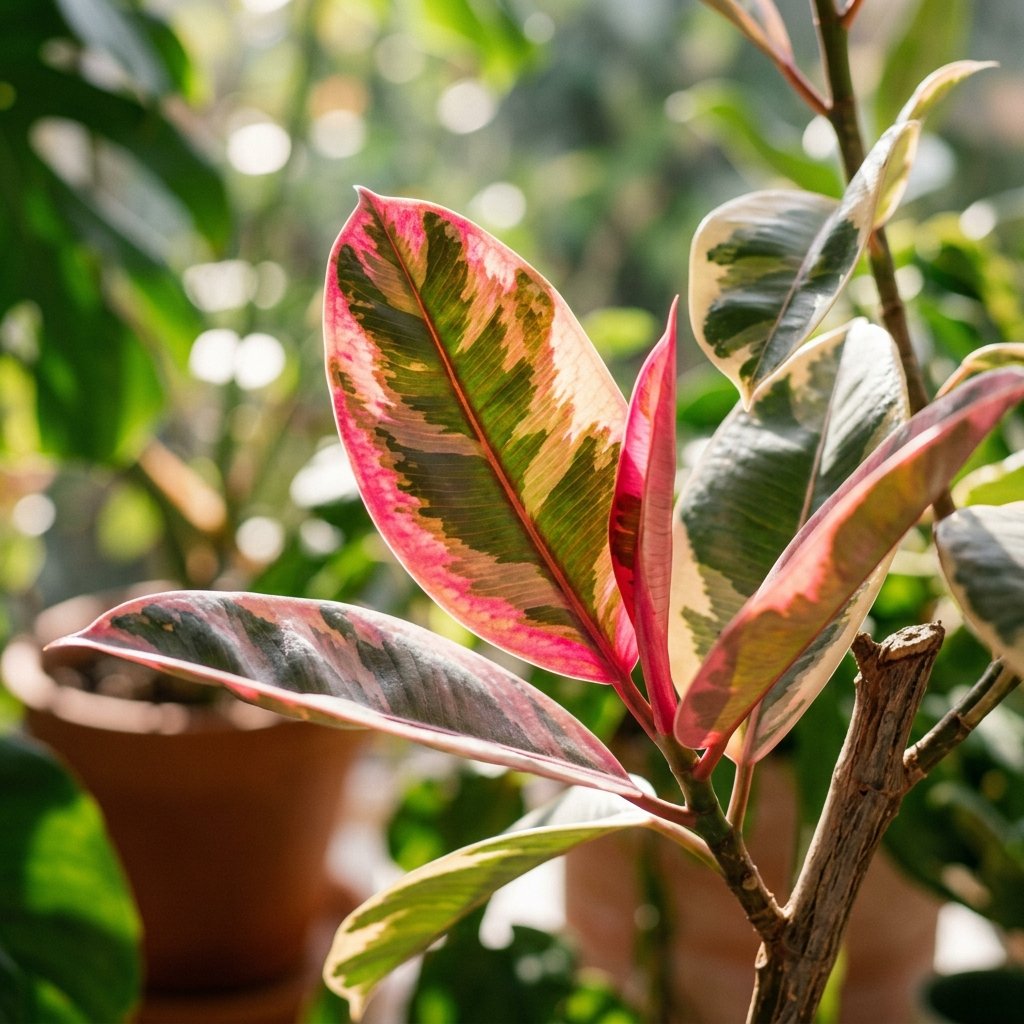

The Ficus Elastica “Tineke” (Variegated Rubber Tree) is arguably the most beautiful, affordable houseplant on the market. When you buy it from the nursery, the edges are brilliant cream and the new leaves emerge a stunning, vibrant ruby-pink. But after six months in your living room, the pink vanishes and the white edges turn into a dull, muddy green. Why does this happen?
The Science of Pink Sun-Stress
Unlike stable white variegation, the pink color on a Ficus Tineke is not actually a genetic mutation you can preserve forever—it is a chemical reaction. The pink hue is caused by anthocyanins, protective pigments the plant produces to shield its tender new cellular tissue from intense, burning UV light. It is quite literally a plant sunburn.
How to Bring the Pink Back
- Light Intensity: A Tineke living 10 feet away from a window will never produce a pink leaf. To force anthocyanin production, the plant must receive direct morning sunlight or sit directly underneath a powerful full-spectrum grow light.
- Age Reversal: Even under perfect light, as a leaf hardens and matures, the pink will naturally fade to cream. The pink is strictly reserved for the newest growth plates.
Reverting to Green: The Survival Mechanism
If your Tineke’s white edges are turning entirely green, your plant is starving to death. White tissue contains zero chlorophyll; it provides no energy to the plant. If the plant is shoved in a dark corner, it realizes it won’t survive, so it overrides the variegation and floods the white tissue with green chlorophyll to maximize whatever weak light is available. Move it to a bright window immediately.
What’s Your Next Step?
You have optimized the light conditions for your Ficus Tineke. Your next action must be to protect that investment from microscopic threats that can reverse your progress overnight. This presents a critical choice:
Frequently Asked Questions
What are the best conditions for this plant?
Most houseplants thrive in bright, indirect light with temperatures between 65-80F (18-27C). Ensure good drainage and water when the top inch of soil feels dry.
How often should I water?
Watering frequency depends on the plant species, pot size, and environment. A general rule is to check the soil moisture before watering. Overwatering is the most common cause of houseplant death.
What soil mix works best?
A well-draining mix of peat moss, perlite, and orchid bark works well for most tropical houseplants. Succulents prefer a grittier mix with more sand and perlite.
Quick Care Reference
| Factor | Requirement | Notes |
|---|---|---|
| Light | Bright indirect | Avoid direct afternoon sun |
| Water | When top inch dry | Reduce in winter |
| Humidity | 50-70% | Mist or use pebble tray |
| Temperature | 65-80F (18-27C) | Avoid cold drafts |
| Soil | Well-draining mix | Peat, perlite, bark |
| Fertilizer | Monthly (spring-summer) | Half-strength balanced |