
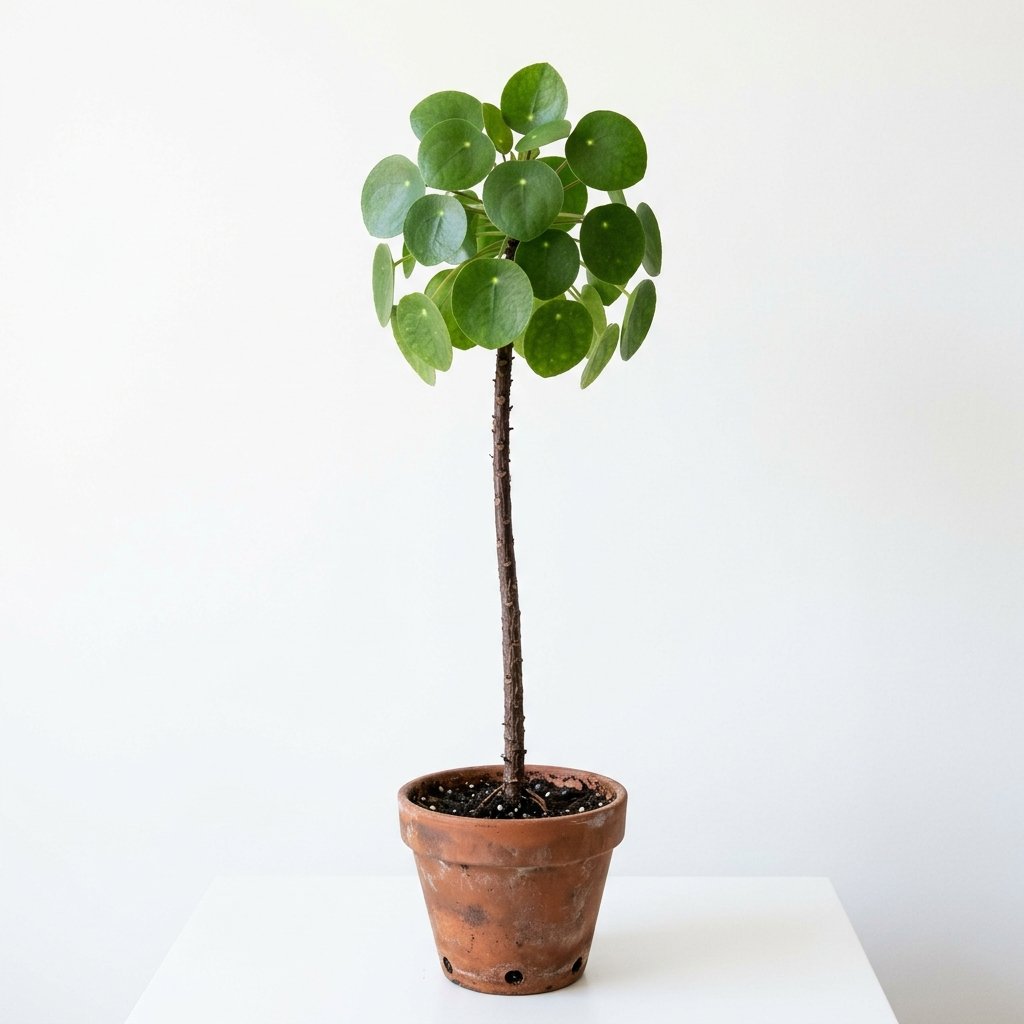

When you buy a Pilea (Chinese Money Plant), it is a compact, uniform dome of circular, lily-pad-like leaves. Six months later, it looks like a Dr. Seuss tree: a tall, barren, skinny wooden stem with a tiny tuft of leaves desperately clinging to the very top. This is known as “Naked Stem Syndrome,” and it is entirely preventable.
Why the Pilea Self-Cannibalizes
The Pilea is an incredibly fast, aggressive grower. Because it pushes new leaves from the top crown simultaneously, it requires an immense amount of nitrogen and light. If you fail to provide a perfect environment, the Pilea realizes it cannot support the new growth. To survive, it chemically drains the nitrogen from its oldest, bottom leaves, turning them yellow, and drops them to feed the top. This results in the creeping, naked stem.
The Two Triggers
- Starvation: Pileas must be heavily fertilized during the growing season. A weak 3-1-2 liquid fertilizer applied weekly will stop the bottom leaves from turning yellow.
- Directional Light: Pileas aggressively reach for light. If you rely on a single window, the plant will strain, stretch, and drop the leaves facing the dark side of the room. You must rotate the pot 45 degrees every time you water.
Fixing the Naked Tree
If your stem is already bare, you cannot force leaves to regrow on the old wood. But you can hack the system using Decapitation (Notching).
Take sterilized shears and literally chop the top half of the Pilea entirely off (you can easily root the top cutting in water to make a second plant). The “decapitation” removes the apical dominance of the main stem. In sheer panic, the bare wooden stump will activate dozens of dormant baby pups all along the naked trunk. Within two months, the ugly stick will transform into a dense, bushy column of new growth.
What’s Your Next Step?
You have successfully diagnosed the “Naked Stem” syndrome. Now, you must optimize your care protocol to prevent its recurrence and ensure the survival of your propagations. Your next decision is critical.
- Are you making the #1 care mistake that 9 out of 10 plant owners believe helps their Pilea, but which biological data proves can actually attract pests and fungal disease?
- After beheading your Pilea, there’s a 70% chance your water-rooted cutting will die within 3 weeks of being potted. Do you know the one biological reason why, and how to prevent it?
Frequently Asked Questions
What are the best conditions for this plant?
Most houseplants thrive in bright, indirect light with temperatures between 65-80F (18-27C). Ensure good drainage and water when the top inch of soil feels dry.
How often should I water?
Watering frequency depends on the plant species, pot size, and environment. A general rule is to check the soil moisture before watering. Overwatering is the most common cause of houseplant death.
What soil mix works best?
A well-draining mix of peat moss, perlite, and orchid bark works well for most tropical houseplants. Succulents prefer a grittier mix with more sand and perlite.
Quick Care Reference
| Factor | Requirement | Notes |
|---|---|---|
| Light | Bright indirect | Avoid direct afternoon sun |
| Water | When top inch dry | Reduce in winter |
| Humidity | 50-70% | Mist or use pebble tray |
| Temperature | 65-80F (18-27C) | Avoid cold drafts |
| Soil | Well-draining mix | Peat, perlite, bark |
| Fertilizer | Monthly (spring-summer) | Half-strength balanced |