
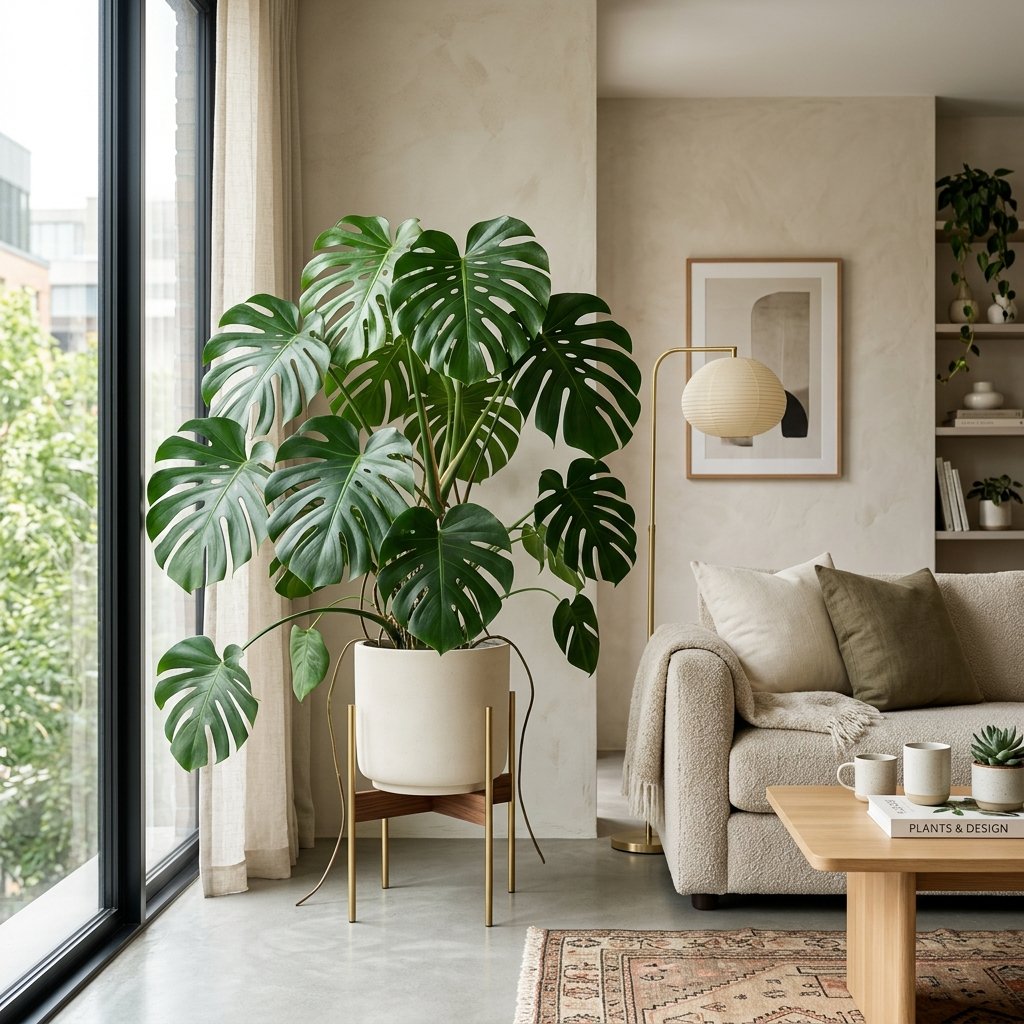

You buy a Monstera Deliciosa. You give it a moss pole, perfect light, and expensive fertilizer. It gets big, but the internodes (the stem between the leaves) are stretched out, the stem remains thin, and it only produces one row of splits on the leaves. You feel like you are doing something wrong. You aren’t. You simply bought a Monstera Borsigiana (Small Form) instead of a True Large Form.
The Genetic Reality of the Monstera
95% of all Monsteras sold in big box stores, IKEA, and local nurseries are the “Small Form” (Borsigiana) variant. It is a wildly fast-growing, vining plant that is much cheaper for commercial nurseries to mass-produce.
How to Identify a True Large Form
A true Monstera Deliciosa Large Form is a crawler, not a climber. It grows significantly slower, but its physical proportions are terrifyingly massive.
- Internodal Spacing: On a Small Form, there are 2 to 4 inches of stem between each leaf. On a Large Form, the nodes are stacked incredibly tight, almost touching each other, creating a massive, thick, unified trunk.
- The Ruffles (Geniculum): Look at the very top of the petiole (the stem connecting the leaf to the main vine) right where it meets the leaf. If it is smooth, it is a Small Form. If it is severely wrinkled, ruffled, and wavy, you have a Large Form.
- Inner Fenestrations: A small form will usually only produce slits that reach the edge of the leaf. A Large Form will easily produce 3 to 4 massive inner holes (secondary fenestrations) surrounding the main vein.
Sourcing the Giant
If you want the iconic, massive, three-foot-wide leaves seen in botanical gardens, stop buying cheap Monsteras to save money. You must specifically purchase a “Large Form” cutting from a high-end collector or a specialized exotic nursery. The genetics dictate the ceiling of the plant’s potential.
What’s Your Next Step?
You have successfully acquired the data to identify your Monstera’s genetic potential. The next logical phase is optimizing its survival and growth trajectory. Consider the following critical variables:
- <a href="https://plantsmag.com
Frequently Asked Questions
What are the best conditions for this plant?
Most houseplants thrive in bright, indirect light with temperatures between 65-80F (18-27C). Ensure good drainage and water when the top inch of soil feels dry.
How often should I water?
Watering frequency depends on the plant species, pot size, and environment. A general rule is to check the soil moisture before watering. Overwatering is the most common cause of houseplant death.
What soil mix works best?
A well-draining mix of peat moss, perlite, and orchid bark works well for most tropical houseplants. Succulents prefer a grittier mix with more sand and perlite.
Quick Care Reference
Factor Requirement Notes Light Bright indirect Avoid direct afternoon sun Water When top inch dry Reduce in winter Humidity 50-70% Mist or use pebble tray Temperature 65-80F (18-27C) Avoid cold drafts Soil Well-draining mix Peat, perlite, bark Fertilizer Monthly (spring-summer) Half-strength balanced