
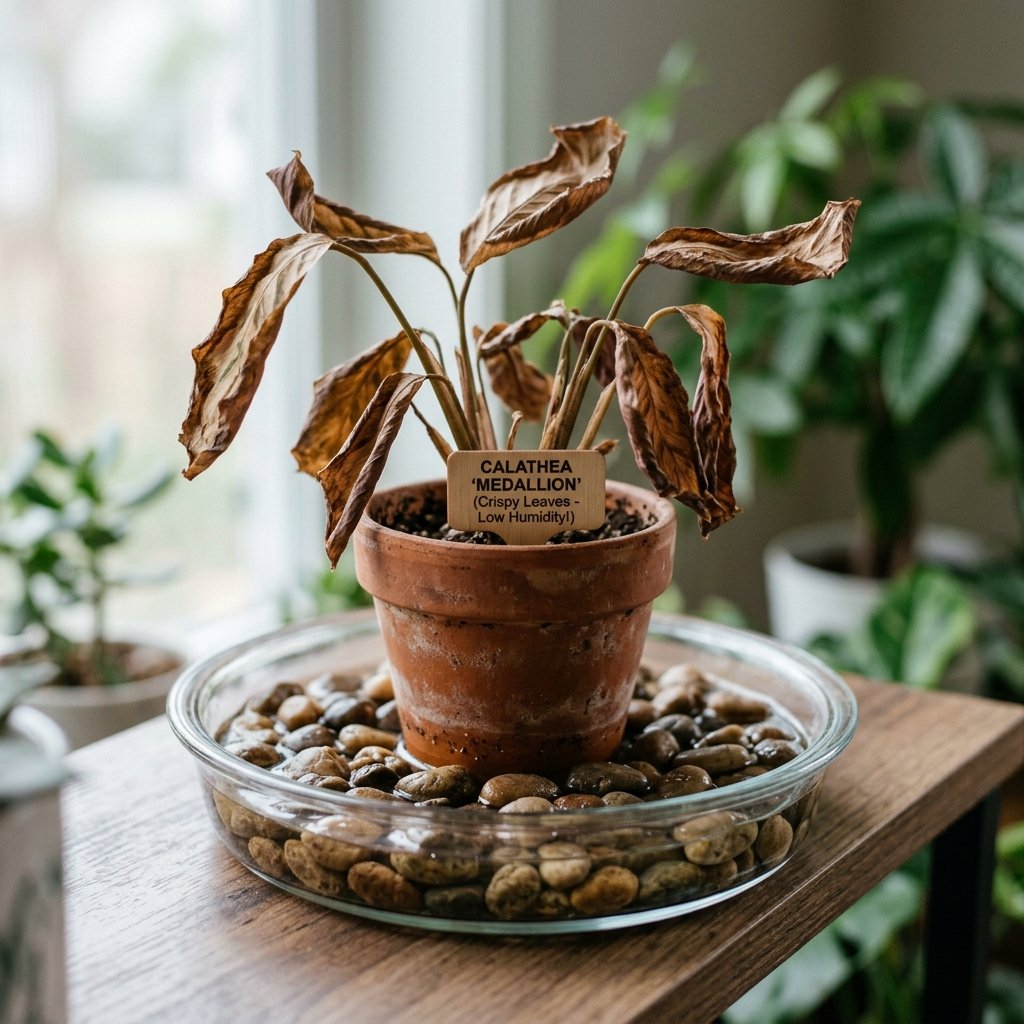

You bought a beautiful, dramatic Calathea. To prevent the edges from turning brown and crispy, you followed classic advice: you filled a shallow tray with pebbles and water, and placed the plant on top. Six months later, the plant is still crispy, and the tray is just full of algae. Welcome to the great Pebble Tray Scam.
The Physics of Evaporation
A humidity tray relies on passive evaporation. The theory is that as the water slowly evaporates from the tray, it creates a “micro-climate” of high humidity directly around the plant’s leaves. Botanists have tested this with highly sensitive hygrometers. The result?
A pebble tray raises the relative humidity directly above it by exactly 1 to 2 percent. If your living room is 35% humidity, the tray makes it 36%. A Tropical Calathea or Anthurium requires 65% to 80% humidity. The tray is mathematically useless.
Real Humidity Solutions
If you genuinely want to stop crispy brown edges, you need active, aggressive moisture management.
- The Humidifier: Buy a warm or cool mist humidifier and place it no more than three feet from the plant. This will actively pump vapor into the air, raising local humidity to 70%.
- The IKEA Greenhouse: Convert a glass cabinet into an indoor greenhouse. Trapping the air in a sealed glass box naturally keeps humidity close to 90%.
- Grouping: Grouping 10 plants tightly together actually does raise the micro-climate humidity because all 10 plants are actively transpiring (sweating) moisture from their leaves.
If your Calathea leaves are already severely damaged, use our AI Disease Finder to ensure the crispiness isn’t actually caused by a hidden Spider Mite infestation.
Frequently Asked Questions
What are the best conditions for this plant?
Most houseplants thrive in bright, indirect light with temperatures between 65-80F (18-27C). Ensure good drainage and water when the top inch of soil feels dry.
How often should I water?
Watering frequency depends on the plant species, pot size, and environment. A general rule is to check the soil moisture before watering. Overwatering is the most common cause of houseplant death.
What soil mix works best?
A well-draining mix of peat moss, perlite, and orchid bark works well for most tropical houseplants. Succulents prefer a grittier mix with more sand and perlite.
Quick Care Reference
| Factor | Requirement | Notes |
|---|---|---|
| Light | Bright indirect | Avoid direct afternoon sun |
| Water | When top inch dry | Reduce in winter |
| Humidity | 50-70% | Mist or use pebble tray |
| Temperature | 65-80F (18-27C) | Avoid cold drafts |
| Soil | Well-draining mix | Peat, perlite, bark |
| Fertilizer | Monthly (spring-summer) | Half-strength balanced |
Pro Tips from a Master Botanist
Beyond the common advice, here are insights honed over decades of professional plant care and horticultural research, offering truly effective strategies for your collection.
1. The “Microclimate Matrix” Over Macro-Humidity
Forget trying to humidify an entire room with a tray. The key to thriving tropicals isn’t a broadly elevated ambient humidity, but rather a *stable microclimate* around the foliage. This involves strategic plant grouping to create a self-sustaining humidity pocket, combined with precise air circulation. A static humidity tray offers negligible impact on the boundary layer of air immediately surrounding a plant’s leaves, especially in a ventilated room. Instead, consider creating a “plant island” where transpiration from multiple plants collectively elevates localized humidity, and ensure a gentle, consistent airflow (not a draft) to prevent fungal issues while still allowing for gas exchange. Think about the physics: water evaporating from a tray disperses rapidly; water transpired by leaves, when grouped, creates a more stable, higher localized vapor pressure.
2. Substrate’s Role: The Unsung Hero of Turgidity
Many growers mistakenly attribute wilting or crispy leaf edges solely to low ambient humidity when the root cause is often inadequate moisture availability at the root zone, leading to poor turgor pressure. While humidity helps reduce transpiration, if the plant isn’t adequately hydrated from the roots up, no amount of ambient humidity will compensate. Focus intensely on your substrate’s water retention capabilities, irrigation schedule, and root health. A well-aerated, consistently moist (not soggy) substrate for tropicals, coupled with proper watering techniques that ensure even saturation, often resolves perceived “humidity issues” far more effectively than any tray ever could. Consider amendments like coco coir, perlite, and bark to achieve optimal moisture balance and aeration.
3. Targeted Vapor Delivery: Humidifiers & Enclosures are King
For plants with genuinely high and critical humidity demands (e.g., Marantaceae, ferns, certain aroids), the only truly effective, scalable, and controllable method is a dedicated humidifier or an enclosed environment. A high-quality ultrasonic humidifier can maintain a consistent 60-80% relative humidity across a significant area, which is magnitudes beyond what a passive tray can achieve. For ultra-demanding specimens, terrariums, cloches, or dedicated grow cabinets act as sealed ecosystems, trapping transpired moisture and creating near-perfect humidity. These methods directly address the atmospheric vapor pressure deficit, which is the actual scientific metric influencing plant water loss, unlike the negligible effect of a small tray of water.
Frequently Asked Questions About Houseplant Humidity