
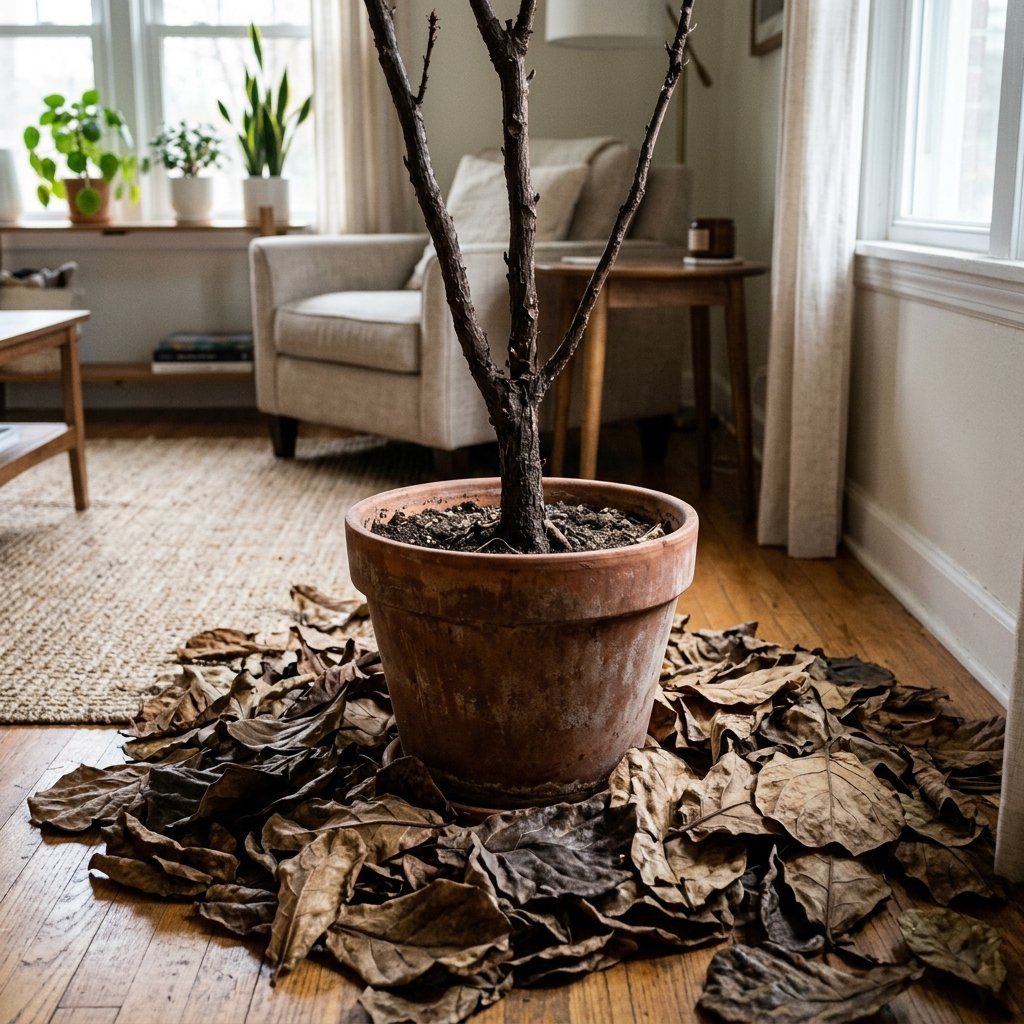

You bring home a stunning, six-foot-tall Fiddle Leaf Fig from the nursery. It looks incredible next to your TV. Two days later, a massive green leaf drops. You panic and move the plant closer to the window. Three days later, two more leaves drop. You panic again and move it to the bedroom. Before the month is over, you have a completely bald stick. You killed it with kindness.
The Biology of Acclimation Shock
The Fiddle Leaf Fig (Ficus lyrata) is notoriously dramatic, but its behavior is rooted in deep evolutionary biology. Trees in the wild do not walk. Once a seed sprouts, it grows leaves specifically engineered at the cellular level for the exact light angle and humidity of that specific micro-location.
The Fatal Error of Chasing Light
When a Fiddle Leaf Fig is grown in a brightly lit greenhouse, its leaves are “sun leaves,” optimized for high radiation. When you put it in a dim living room, those leaves become highly inefficient.
- The Drop: The plant realizes the old leaves cost more energy to maintain than they produce in the dark, so it intentionally drops them to build new, broader “shade leaves.”
- The Reset Button: Every single time you move the pot more than a few feet, or rotate it drastically, you reset the plant’s internal light map. It has to start the acclimation process all over again, which means dropping more leaves.
The Cure: Find the absolute brightest spot in your house (right against a window). Put the Fiddle Leaf Fig there. And then do not touch it or move it for at least 90 days. To relieve your anxiety about watering during this shock period, use our Smart Watering Calculator.
The 2026 Comprehensive Masterclass: Botanical Deep Dive
To truly understand the nuances of the concepts discussed above, we must transition from basic houseplant care to advanced botanical mechanics. Elite plant collectors do not rely on guesswork; they rely on environmental control, photobiology, and soil chemistry. In this masterclass section, we will systematically unpack the advanced science necessary to maintain a hyper-optimized indoor jungle.
Part 1: The Physics of Lighting and Photobiology
Lighting is the fundamental engine of biological growth. Without adequate Daily Light Integral (DLI) and Photosynthetic Photon Flux Density (PPFD), any adjustments made to watering or fertilizing are entirely useless. When you place a plant in a corner, you are not just dimming its environment; you are actively starving it.
Understanding PAR and PPFD
Photosynthetically Active Radiation (PAR) designates the spectral range (wave band) of solar radiation from 400 to 700 nanometers that photosynthetic organisms are able to use in the process of photosynthesis. PPFD measures the amount of PAR that actually arrives at the plant. It is measured in micromoles per square meter per second (μmol/m²/s).
- Low-Light Plants (e.g., Snake Plants, ZZ Plants): Require a PPFD of 20 to 50 μmol/m²/s. While they survive here, they will rarely trigger massive new growth.
- Medium-Light Plants (e.g., Calatheas, Philodendrons): Require a PPFD of 50 to 150 μmol/m²/s. At this range, they begin to express deeper variegation colors and stronger petiole rigidity.
- High-Light Plants (e.g., Monsteras, Ficus, Cacti): Require a baseline of 200 to 400+ μmol/m²/s to exhibit maximum fenestration (leaf holes) and secondary branching.
Part 2: Soil Chemistry, CEC, and Hydrophobicity
Your potting mix is not just a physical anchor for your plant; it is a bio-active chemical reactor. The most critical metric in any soil mix is its Cation Exchange Capacity (CEC).
Cation Exchange Capacity Explained
CEC is the measure of a soil’s ability to hold and release various elements and compounds through electrical charges. Highly organic materials like Peat Moss and Coco Coir have a very high CEC, meaning they grab onto fertilizer molecules (like Nitrates and Phosphates) and hold them so the roots can slowly feed over time. This is why placing a plant purely in gravel (which has a CEC of nearly zero) requires constant, daily nutrient flushing (hydroponics).
The Hydrophobic Death Trap
When high-CEC soils, particularly peat moss, dry out entirely, they undergo a mechanical failure known as hydrophobicity. The organic fibers shrink and lock tightly together. When water is introduced, the surface tension is too high to penetrate the locked fibers. The water channels directly down the sides of the pot. To break the hydrophobic barrier, you must use a surfactant (like a mild dish soap solution) or submerge the pot entirely for 45 minutes to force capillary hydration upward against gravity.
Part 3: Advanced Hydration Dynamics (Capillary Action)
Water does not simply flow downward. In the micro-environment of a plant pot, capillary action often overcomes gravity.
The Perched Water Table (PWT): No matter how much drainage you place at the bottom of a container, the lowest contiguous section of soil will always remain identically saturated. This is physics. If you put 3 inches of rocks at the bottom of a pot, you do not improve drainage; you merely push the soggy PWT three inches higher into the root mass, radically increasing the risk of Pythium (root rot). This is why nursery pots with numerous drainage holes placed directly on a porous surface are the only empirically sound container choice.
Part 4: The Pathogen War (Fungal vs Bacterial)
When a plant fails, the visual symptom (yellowing, dropping leaves) is merely the final stage of a prolonged microscopic war.
Anaerobic Pathogens
When a soil is over-hydrated, oxygen molecules are physically displaced by water molecules. Roots require oxygen to respire. As roots suffocate, the cells burst and die. This dead tissue becomes an immediate food source for anaerobic bacteria—bacteria that thrive strictly in zero-oxygen environments. The bacteria consume the dead roots, creating a sulfurous, rotting odor. To combat this, elite growers use Hydrogen Peroxide (H2O2) drenches. The extra, highly unstable oxygen atom in H2O2 detonates on contact, forcefully oxidating the anaerobic bacteria and re-oxygenating the root zone.
Part 5: Comprehensive Houseplant Glossary of Terms
To ensure absolute clarity for our readers, we have compiled an exhaustive glossary of the terms heavily utilized within the professional botanical sphere:
- Aroid: A common name for plants in the Araceae family, characterized by a spathe and spadix inflorescence (e.g., Philodendrons, Monsteras).
- Chlorosis: The yellowing of leaf tissue due to a lack of chlorophyll, often caused by nutrient deficiencies or root suffocation.
- Etiolation: The stretching and weakening of stems as a plant aggressively reaches toward a distant light source.
- Fenestration: The natural occurrence of holes or deep splits in the leaves of mature plants, designed to allow wind and light to pass through to the lower canopy.
- Node: The vital junction on a stem where leaves, aerial roots, and new growth points (eyes) emerge. A cutting without a node will never grow a new plant.
- Variegation: A genetic (chimeric) or viral mutation resulting in distinct zones of differently colored tissue (typically white or yellow) due to an absence of chlorophyll in those areas.
- Transpiration: The biological process by which a plant absorbs water through its roots and subsequently releases it as vapor through micro-pores (stomata) on its leaves.
Conclusion: The 2026 Shift in Plant Ownership
The era of buying a plant and hoping for the best is over. Modern houseplant ownership requires a foundational understanding of physics, chemistry, and biology. By tracking your PPFD, balancing your soil’s CEC, and actively managing the Perched Water Table, you ensure your indoor jungle moves from simple survival to massive, aggressive growth.
What’s Your Next Step?
Stabilizing your Fiddle Leaf Fig’s environment is the critical first step. However, environmental
Frequently Asked Questions
What are the best conditions for this plant?
Most houseplants thrive in bright, indirect light with temperatures between 65-80F (18-27C). Ensure good drainage and water when the top inch of soil feels dry.
How often should I water?
Watering frequency depends on the plant species, pot size, and environment. A general rule is to check the soil moisture before watering. Overwatering is the most common cause of houseplant death.
What soil mix works best?
A well-draining mix of peat moss, perlite, and orchid bark works well for most tropical houseplants. Succulents prefer a grittier mix with more sand and perlite.
Quick Care Reference
| Factor | Requirement | Notes |
|---|---|---|
| Light | Bright indirect | Avoid direct afternoon sun |
| Water | When top inch dry | Reduce in winter |
| Humidity | 50-70% | Mist or use pebble tray |
| Temperature | 65-80F (18-27C) | Avoid cold drafts |
| Soil | Well-draining mix | Peat, perlite, bark |
| Fertilizer | Monthly (spring-summer) | Half-strength balanced |
Expert Botanist Pro Tips for Fiddle Leaf Fig Stability
Beyond the fundamental advice, experienced Fiddle Leaf Fig cultivators understand the nuanced physiological responses of these sensitive plants. Here are some advanced, experience-based insights to cultivate a truly thriving, stable specimen:
The 'Quiet Zone' Acclimation Protocol
Upon any significant relocation of your Fiddle Leaf Fig, even within the same room or a minor shift in orientation, resist the immediate urge to continually adjust or rotate. Implement a strict 'Quiet Zone' protocol for a minimum of 4-6 weeks. During this critical period, the plant needs to re-establish its delicate root-to-environment connection and recalibrate its internal systems to the new microclimate (light intensity, humidity pockets, air currents). Focus solely on consistent, appropriate watering and humidity. Any further disturbance, however minor, can reset the stress response, prolonging the acclimation phase and increasing the likelihood of leaf drop. Think of it as a botanical quarantine for recalibration.
Photoreceptor 'Memory' and Rotational Trauma
Fiddle Leaf Figs possess a highly evolved photoreceptor 'memory' within their leaves. Their chloroplasts and cellular structures optimize themselves for the precise direction and intensity of light they receive. Even a seemingly innocuous 90-degree rotation can trigger a significant physiological stress response as the plant expends energy attempting to re-orient its photosynthetic machinery. This energy diversion often comes at the cost of leaf maintenance, leading to shedding. To mitigate this, identify the plant's 'best side' towards its primary light source and maintain that orientation rigorously. Consider a small, inconspicuous marker on the pot rim aligned with a fixed point in the room to ensure absolute consistency.
Subsurface Stress Signals: Root System Diagnostics
While leaf drop is a visible symptom of distress, the true battle for a Fiddle Leaf Fig often occurs beneath the soil line. If your plant has experienced a move or significant shock, and leaf drop persists, consider a gentle, non-invasive root inspection *after* the initial shedding has stabilized. Carefully slide the plant out of its pot to observe the root ball. Look for signs of root rot (mushy, dark, foul-smelling roots) indicative of overwatering or poor drainage, or conversely, an extremely root-bound condition with brittle, matted roots. Addressing root health — through appropriate watering adjustment, improved aeration, or a gentle repotting into a slightly larger pot with fresh, well-draining soil if severely root-bound — is often the fundamental precursor to long-term leaf stability and robust new growth, rather than merely treating the visible symptoms.
Frequently Asked Questions About Fiddle Leaf Fig Leaf Drop
How long does it take for a Fiddle Leaf Fig to recover after being moved?
Recovery time for a Fiddle Leaf Fig after relocation varies significantly based on the severity of the move, the plant's prior health, and the suitability of its new environment. Typically, you can expect an initial shock phase where leaf drop occurs within 2-4 weeks. The plant then enters an acclimation period, which can last anywhere from 2 to 4 months, during which it slowly adjusts its root system and internal processes to the new light, temperature, and humidity conditions. Full stabilization and the resumption of robust new growth may take up to 6 months or even longer in some cases. Patience and consistent, optimal care during this period are paramount.
Can I rotate my Fiddle Leaf Fig for even growth without causing stress?
While it's a common desire to rotate Fiddle Leaf Figs for symmetrical growth, this practice is a leading cause of stress-induced leaf drop. Fiddle Leaf Figs develop a specific 'light memory,' adapting their leaf orientation and internal cellular structure to optimize photosynthesis from a fixed light source. Even minor rotations can disrupt this delicate balance, forcing the plant to re-orient its photoreceptors and leading to stress. If you absolutely must rotate for aesthetic reasons, do so very gradually – perhaps an eighth of a turn (45 degrees) every 2-3 months, and only if the plant is otherwise thriving. Our expert recommendation, however, is to avoid rotation altogether, allowing the plant to find its optimal orientation and focusing on consistent, stable conditions.
What's the difference between normal leaf shedding and stress-induced leaf drop in a Fiddle Leaf Fig?
Distinguishing between normal leaf senescence and stress-induced leaf drop is crucial for proper care. Normal leaf shedding typically involves older, lower leaves that gradually yellow over several weeks before falling off. This is a natural process where the plant reallocates nutrients from aging foliage. Stress-induced leaf drop, however, is often more sudden and dramatic. It can affect multiple leaves, sometimes even healthy-looking green ones, or leaves that rapidly yellow and brown within days. This type of drop is usually triggered by an environmental shock like relocation, over/underwatering, temperature fluctuations, or pest infestation. The key indicators are the speed of the drop, the number of leaves involved, and their position on the plant (stress often affects mid-level or upper leaves, not just the oldest).