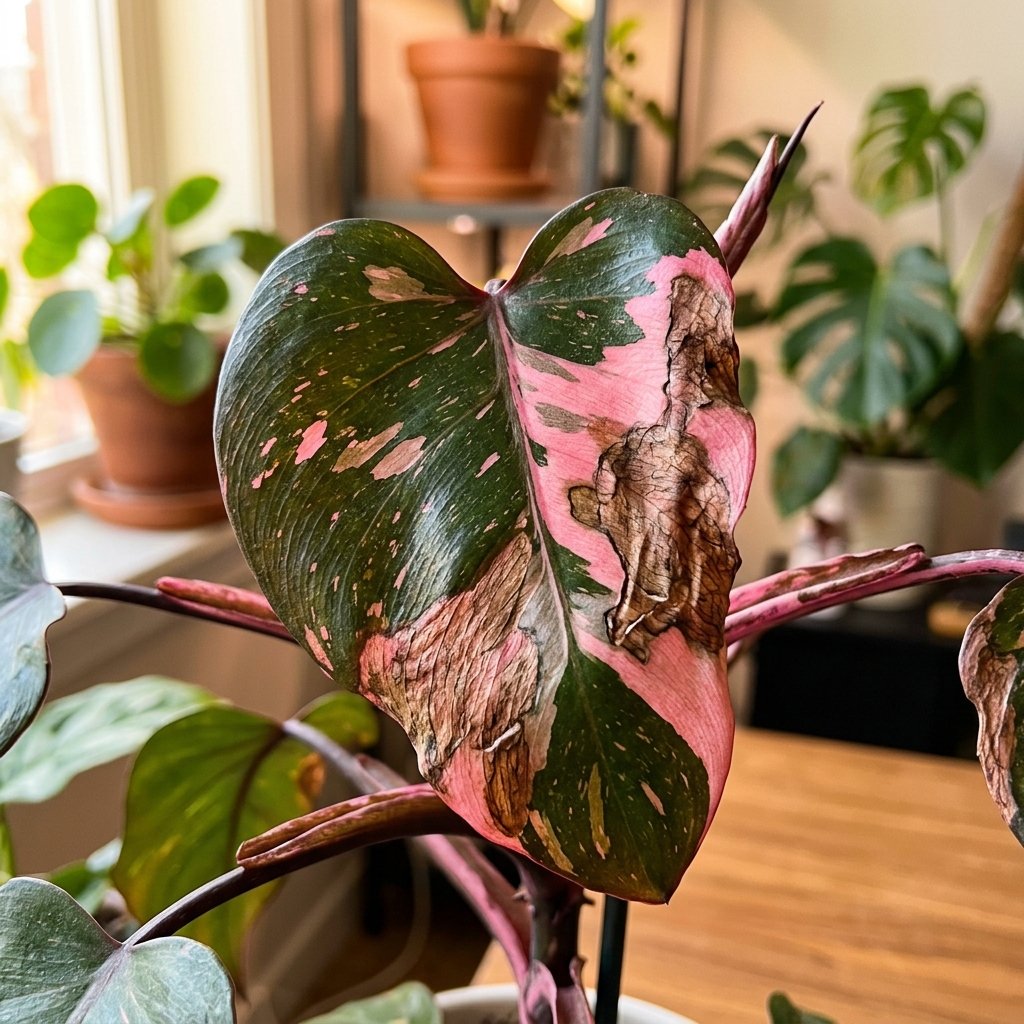

You finally saved up and bought a highly sought-after Philodendron Pink Princess. Half the leaves are a stunning, vibrant bubblegum pink. You put it in a bright west-facing window to encourage more pink. But within a month, the beautiful pink sections begin to turn yellow, thin out, and eventually turn into crispy brown paper, while the dark green sections remain perfectly healthy. What went wrong?
The Curse of the Chimera
Variegation in plants (whether white on a Monstera Albo or pink on a Princess) is caused by a genetic mutation where the cellular tissue completely lacks chlorophyll. Chlorophyll is the green pigment that absorbs light and turns it into energy. Because the pink sections have no chlorophyll, they are completely useless to the plant. They are dead weight, parasitic passengers kept alive entirely by the green sections.
The Phototoxicity Burn
Chlorophyll also acts as a biological sunscreen. It absorbs ultraviolet and intense radiation, converting it safely into sugars. The pink and white sections have no “sunscreen.”
- Cellular Collapse: When you place a highly variegated leaf in direct, intense sunlight, the green tissue processes the light normally. The colored tissue, however, absorbs the massive radiation without any processing mechanism. The intense energy boils and overheats the pink cells, causing rapid cellular collapse and necrosis (browning).
- The Balancing Act: To keep a Pink Princess pink, you must walk a tightrope. It needs high-quality, long-duration indirect light (high PPFD via full-spectrum LEDs) so the minimal green tissue can feed the entire plant, but it must be entirely shielded from direct, hot rays of physical sunlight that will burn the delicate mutation. Use our AI Disease Finder to confirm if a crispy edge is phototoxic sunburn or a fungal attack.
WhatFrequently Asked Questions
What are the best conditions for this plant?
Most houseplants thrive in bright, indirect light with temperatures between 65-80F (18-27C). Ensure good drainage and water when the top inch of soil feels dry.
How often should I water?
Watering frequency depends on the plant species, pot size, and environment. A general rule is to check the soil moisture before watering. Overwatering is the most common cause of houseplant death.
What soil mix works best?
A well-draining mix of peat moss, perlite, and orchid bark works well for most tropical houseplants. Succulents prefer a grittier mix with more sand and perlite.
Quick Care Reference
What are the best conditions for this plant?
Most houseplants thrive in bright, indirect light with temperatures between 65-80F (18-27C). Ensure good drainage and water when the top inch of soil feels dry.
How often should I water?
Watering frequency depends on the plant species, pot size, and environment. A general rule is to check the soil moisture before watering. Overwatering is the most common cause of houseplant death.
What soil mix works best?
A well-draining mix of peat moss, perlite, and orchid bark works well for most tropical houseplants. Succulents prefer a grittier mix with more sand and perlite.
| Factor | Requirement | Notes |
|---|---|---|
| Light | Bright indirect | Avoid direct afternoon sun |
| Water | When top inch dry | Reduce in winter |
| Humidity | 50-70% | Mist or use pebble tray |
| Temperature | 65-80F (18-27C) | Avoid cold drafts |
| Soil | Well-draining mix | Peat, perlite, bark |
| Fertilizer | Monthly (spring-summer) | Half-strength balanced |
Advanced Pro Tips for Mastering Variegated Plant Lighting
Beyond the basics of “bright indirect light,” truly thriving variegated plants, especially sensitive cultivars like the ‘Pink Princess’ Philodendron, demand a nuanced understanding of light dynamics. Here are some insights from extensive cultivation experience:
1. Calibrating Light with PAR Meters: Beyond Foot-Candles
While foot-candles offer a general idea, Photosynthetically Active Radiation (PAR) is the gold standard for measuring light quality for plant growth. For most variegated plants, aim for a PAR range of 150-300 µmol/m²/s during their primary growth phase for optimal variegation without stress. A ‘Pink Princess’ often thrives closer to the 200-250 µmol/m²/s mark. Investing in an affordable PAR meter (or a smartphone app with a decent sensor) allows for precise placement and adjustment, preventing the common pitfalls of over or under-lighting. Remember, even a few inches can drastically change PAR values, especially with artificial lights.
2. The Microclimate Acclimation Protocol: A Gentle Transition is Key
Variegated plants are particularly susceptible to sudden environmental shifts. When relocating a plant—even from one room to another, or under a new grow light—implement a gradual acclimation protocol. Start by placing the plant further away from the intended light source, then incrementally move it closer over a period of 1-2 weeks. Observe leaf texture, color saturation, and any signs of stress (e.g., dulling variegation, slight wilting, or early browning). This prevents photobleaching or shock, allowing the plant’s cells to adjust their photosynthetic machinery to the new light intensity and spectrum. This is especially critical when bringing plants outdoors or introducing them to high-intensity grow lights.
3. The Role of Micronutrients in Variegation Stability and Browning Prevention
While light is paramount, the stability and vibrancy of variegation are intrinsically linked to nutrient availability, especially micronutrients. Magnesium (Mg) is a core component of chlorophyll, and iron (Fe) is vital for chlorophyll synthesis. Deficiencies in these can lead to chlorosis (yellowing) that can be mistaken for light stress, or exacerbate browning issues. Ensure your fertilization regimen includes a balanced micro-nutrient profile. Chelated forms of iron and magnesium are often more readily available to plants. A healthy, nutrient-replete plant is far more resilient to slight fluctuations in light and less prone to ‘burning’ or browning even when exposed to slightly higher light levels.
Frequently Asked Questions About Variegated Plants & Light