
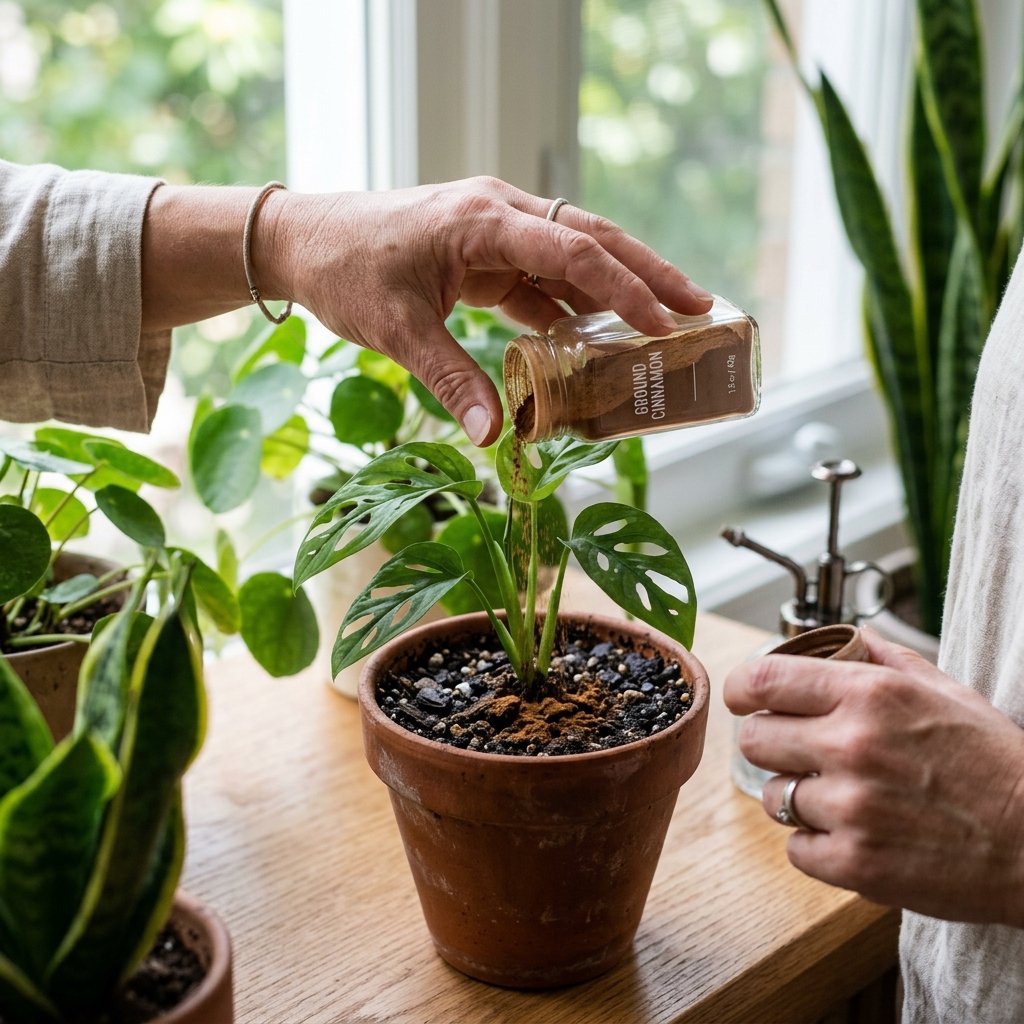

A white, fuzzy mold appears on the surface of your potting soil. You turn to TikTok for a hack, and a 20-second video tells you to “Just sprinkle ground cinnamon on top! It’s a natural fungicide!” You dump your kitchen spice jar onto your plant. Three weeks later, the mold is back, and now your Fungus Gnat problem is worse. The cinnamon hack is wildly misunderstood.
The Cinnamaldehyde Reality
It is true that Cinnamaldehyde (the chemical compound that gives cinnamon its flavor) has proven fungicidal and anti-microbial properties in laboratory settings. The critical error lies in the concentration and the medium.
The cheap, ground “Cassia” cinnamon sitting in your kitchen pantry contains extremely low, diluted amounts of active cinnamaldehyde. When you sprinkle this dry powder onto continuously wet, decomposing organic potting soil, it does not act as a forcefield. Instead, because it is organic bark dust, it quickly gets wet and physically becomes food for the fungus.
Where Cinnamon Actually Works
Do not throw away your cinnamon; it is highly effective, but only when used correctly in dry applications.
- Sealing Wounds: If you take a tip-cutting of a Monstera or prune a Fiddle Leaf Fig, the exposed open wound acts like an open artery, inviting airborne bacteria. If you dab a dry finger into cinnamon powder and press it directly onto the wet, freshly cut sap of the wound, it acts as a phenomenal organic styptic powder. It instantly dries and seals the wound, preventing rot before propagation.
- The Real Soil Fix: If your soil has surface mold, cinnamon will not save it. The mold means your soil remains wet for far too long. Take a spoon, scrape off the top inch of moldy dirt, throw it away, and mix coarse Perlite into the remaining soil to massively increase airflow.
The 2026 Comprehensive Masterclass: Botanical Deep Dive
To truly understand the nuances of the concepts discussed above, we must transition from basic houseplant care to advanced botanical mechanics. Elite plant collectors do not rely on guesswork; they rely on environmental control, photobiology, and soil chemistry. In this masterclass section, we will systematically unpack the advanced science necessary to maintain a hyper-optimized indoor jungle.
Part 1: The Physics of Lighting and Photobiology
Lighting is the fundamental engine of biological growth. Without adequate Daily Light Integral (DLI) and Photosynthetic Photon Flux Density (PPFD), any adjustments made to watering or fertilizing are entirely useless. When you place a plant in a corner, you are not just dimming its environment; you are actively starving it.
Understanding PAR and PPFD
Photosynthetically Active Radiation (PAR) designates the spectral range (wave band) of solar radiation from 400 to 700 nanometers that photosynthetic organisms are able to use in the process of photosynthesis. PPFD measures the amount of PAR that actually arrives at the plant. It is measured in micromoles per square meter per second (μmol/m²/s).
- Low-Light Plants (e.g., Snake Plants, ZZ Plants): Require a PPFD of 20 to 50 μmol/m²/s. While they survive here, they will rarely trigger massive new growth.
- Medium-Light Plants (e.g., Calatheas, Philodendrons): Require a PPFD of 50 to 150 μmol/m²/s. At this range, they begin to express deeper variegation colors and stronger petiole rigidity.
- High-Light Plants (e.g., Monsteras, Ficus, Cacti): Require a baseline of 200 to 400+ μmol/m²/s to exhibit maximum fenestration (leaf holes) and secondary branching.
Part 2: Soil Chemistry, CEC, and Hydrophobicity
Your potting mix is not just a physical anchor for your plant; it is a bio-active chemical reactor. The most critical metric in any soil mix is its Cation Exchange Capacity (CEC).
Cation Exchange Capacity Explained
CEC is the measure of a soil’s ability to hold and release various elements and compounds through electrical charges. Highly organic materials like Peat Moss and Coco Coir have a very high CEC, meaning they grab onto fertilizer molecules (like Nitrates and Phosphates) and hold them so the roots can slowly feed over time. This is why placing a plant purely in gravel (which has a CEC of nearly zero) requires constant, daily nutrient flushing (hydroponics).
The Hydrophobic Death Trap
When high-CEC soils, particularly peat moss, dry out entirely, they undergo a mechanical failure known as hydrophobicity. The organic fibers shrink and lock tightly together. When water is introduced, the surface tension is too high to penetrate the locked fibers. The water channels directly down the sides of the pot. To break the hydrophobic barrier, you must use a surfactant (like a mild dish soap solution) or submerge the pot entirely for 45 minutes to force capillary hydration upward against gravity.
Part 3: Advanced Hydration Dynamics (Capillary Action)
Water does not simply flow downward. In the micro-environment of a plant pot, capillary action often overcomes gravity.
The Perched Water Table (PWT): No matter how much drainage you place at the bottom of a container, the lowest contiguous section of soil will always remain identically saturated. This is physics. If you put 3 inches of rocks at the bottom of a pot, you do not improve drainage; you merely push the soggy PWT three inches higher into the root mass, radically increasing the risk of Pythium (root rot). This is why nursery pots with numerous drainage holes placed directly on a porous surface are the only empirically sound container choice.
Part 4: The Pathogen War (Fungal vs Bacterial)
When a plant fails, the visual symptom (yellowing, dropping leaves) is merely the final stage of a prolonged microscopic war.
Anaerobic Pathogens
When a soil is over-hydrated, oxygen molecules are physically displaced by water molecules. Roots require oxygen to respire. As roots suffocate, the cells burst and die. This dead tissue becomes an immediate food source for anaerobic bacteria—bacteria that thrive strictly in zero-oxygen environments. The bacteria consume the dead roots, creating a sulfurous, rotting odor. To combat this, elite growers use Hydrogen Peroxide (H2O2) drenches. The extra, highly unstable oxygen atom in H2O2 detonates on contact, forcefully oxidating the anaerobic bacteria and re-oxygenating the root zone.
Part 5: Comprehensive Houseplant Glossary of Terms
To ensure absolute clarity for our readers, we have compiled an exhaustive glossary of the terms heavily utilized within the professional botanical sphere:
- Aroid: A common name for plants in the Araceae family, characterized by a spathe and spadix inflorescence (e.g., Philodendrons, Monsteras).
- Chlorosis: The yellowing of leaf tissue due to a lack of chlorophyll, often caused by nutrient deficiencies or root suffocation.
- Etiolation: The stretching and weakening of stems as a plant aggressively reaches toward a distant light source.
- Fenestration: The natural occurrence of holes or deep splits in the leaves of mature plants, designed to allow wind and light to pass through to the lower canopy.
- Node: The vital junction on a stem where leaves, aerial roots, and new growth points (eyes) emerge. A cutting without a node will never grow a new plant.
- Variegation: A genetic (chimeric) or viral mutation resulting in distinct zones of differently colored tissue (typically white or yellow) due to an absence of chlorophyll in those areas.
- Transpiration: The biological process by which a plant absorbs water through its roots and subsequently releases it as vapor through micro-pores (stomata) on its leaves.
Conclusion: The 2026 Shift in Plant Ownership
The era of buying a plant and hoping for the best is over. Modern houseplant ownership requires a foundational understanding of physics, chemistry, and biology. By tracking your PPFD, balancing your soil’s CEC, and actively managing the Perched Water Table, you ensure your indoor jungle moves from simple survival to massive, aggressive growth.
What’s Your Next Step?
You have now corrected a common piece of misinformation. My analysis indicates that a proactive approach to plant science is the optimal path to success. The next logical step is to address other knowledge gaps that may be impacting your collection.
- Are you making the #1 mistake that causes 80% of Fiddle Leaf Figs to drop their leaves? (Analysis: It is not what you think.)
- <a
Frequently Asked Questions
What are the best conditions for this plant?
Most houseplants thrive in bright, indirect light with temperatures between 65-80F (18-27C). Ensure good drainage and water when the top inch of soil feels dry.
How often should I water?
Watering frequency depends on the plant species, pot size, and environment. A general rule is to check the soil moisture before watering. Overwatering is the most common cause of houseplant death.
What soil mix works best?
A well-draining mix of peat moss, perlite, and orchid bark works well for most tropical houseplants. Succulents prefer a grittier mix with more sand and perlite.
Quick Care Reference
Factor Requirement Notes Light Bright indirect Avoid direct afternoon sun Water When top inch dry Reduce in winter Humidity 50-70% Mist or use pebble tray Temperature 65-80F (18-27C) Avoid cold drafts Soil Well-draining mix Peat, perlite, bark Fertilizer Monthly (spring-summer) Half-strength balanced Pro Tips from Our Expert Botanist
Leveraging years of experience in mycology and plant pathology, here are advanced insights to truly understand and combat mold:
Pro Tip 1: Differentiate Between Prevention and Eradication – The Bioactivity Nuance
While cinnamon contains potent compounds like cinnamaldehyde and eugenol known for their broad-spectrum antimicrobial properties, their effectiveness against established mold colonies is often negligible. These compounds primarily act as fungistatic agents, inhibiting the growth of certain fungi or bacteria in high concentrations, particularly in controlled lab settings or as preservatives. For a thriving, embedded mold colony, the required concentration and contact time to achieve fungicidal (killing) effects are impractical and often ineffective in a home environment, especially on porous surfaces where mycelial growth is deep-seated. Real-world application rarely achieves the necessary bioactivity to penetrate and destroy a complex fungal structure. Focus your efforts on actual fungicides or, better yet, preventative measures.
Pro Tip 2: The Moisture Source is Paramount – Surface Treatment is Temporary
An expert botanist understands that mold is merely the symptom of a deeper issue: uncontrolled moisture. Attempting to “kill” visible mold without identifying and rectifying the underlying moisture source (e.g., leaky pipes, condensation, high humidity) is a futile exercise. Even if you temporarily remove the visible growth, the mold will inevitably return as long as the conditions for its survival persist. Our experience shows that a holistic approach focusing on moisture control – proper ventilation, dehumidification, and structural repairs – is infinitely more critical than any surface-level “fungicide,” natural or synthetic. True remediation begins with moisture management.
Pro Tip 3: Dead Mold is Still a Problem – Focus on Removal, Not Just “Killing”
A common misconception is that once mold is “killed,” the problem is solved. From an ecological and health perspective, this is incorrect. Dead mold spores, fragments, and mycotoxins can still trigger allergic reactions, asthma attacks, and other health issues in sensitive individuals. Therefore, effective mold remediation is not just about stopping growth; it’s crucially about safe and thorough physical removal of the mold and contaminated materials. Always use appropriate personal protective equipment (PPE) and containment to prevent spore dispersal, and ensure the affected area is meticulously cleaned and dried. If the mold isn’t removed, the health risks can persist.
Frequently Asked Questions About Mold & Fungicides
If cinnamon doesn’t kill mold, why do some sources suggest it as a natural remedy?
The confusion often stems from cinnamon’s well-documented antimicrobial properties, particularly its ability to inhibit the growth of certain bacteria and some fungi (like yeast or mildews) in specific, high concentrations. Compounds like cinnamaldehyde are effective as preservatives or preventative agents in food science or against superficial microbial films. However, an established mold colony on a porous surface is a robust, complex organism with deeply embedded hyphae. The concentrations achievable and safely applicable in a home setting are insufficient to penetrate, kill, and remove such growth. Many natural remedies are based on anecdotal evidence or laboratory results that don’t translate effectively to real-world mold remediation challenges.
What are the immediate dangers or risks of trying to use cinnamon to treat mold in my home?
The primary danger of relying on cinnamon for mold treatment is the delay in addressing the problem effectively. While you’re attempting an ineffective remedy, the mold continues to spread, potentially causing greater structural damage to your home and exacerbating health risks from prolonged exposure to spores and mycotoxins. Additionally, directly applying powdered cinnamon can create airborne particles that may irritate respiratory passages, especially for those with allergies or asthma. It also doesn’t solve the underlying moisture issue, guaranteeing the mold’s return, and can even stain surfaces.
As a botanist, what are your top recommended safe and effective alternatives for small, non-toxic mold issues?
For small, surface-level mold issues (less than 10 sq ft) on non-porous materials, I recommend: 1. Diluted White Vinegar: A 50/50 solution of white vinegar and water can be sprayed on the mold, left for an hour, and then wiped away. Vinegar is a mild acid that can kill about 82% of mold species. 2. Hydrogen Peroxide: A 3% hydrogen peroxide solution can be sprayed, left for 10-15 minutes, and then scrubbed. It’s an antifungal, antiviral, and antibacterial agent. 3. Baking Soda: Dissolve a quarter teaspoon of baking soda in a spray bottle of water, spray on the mold, scrub, and then spray again to leave a protective layer. It’s a mild disinfectant and deodorizer. Always ensure adequate ventilation, wear gloves and a mask, and address the moisture source immediately. For larger infestations or if you suspect toxic mold, professional remediation is essential.