
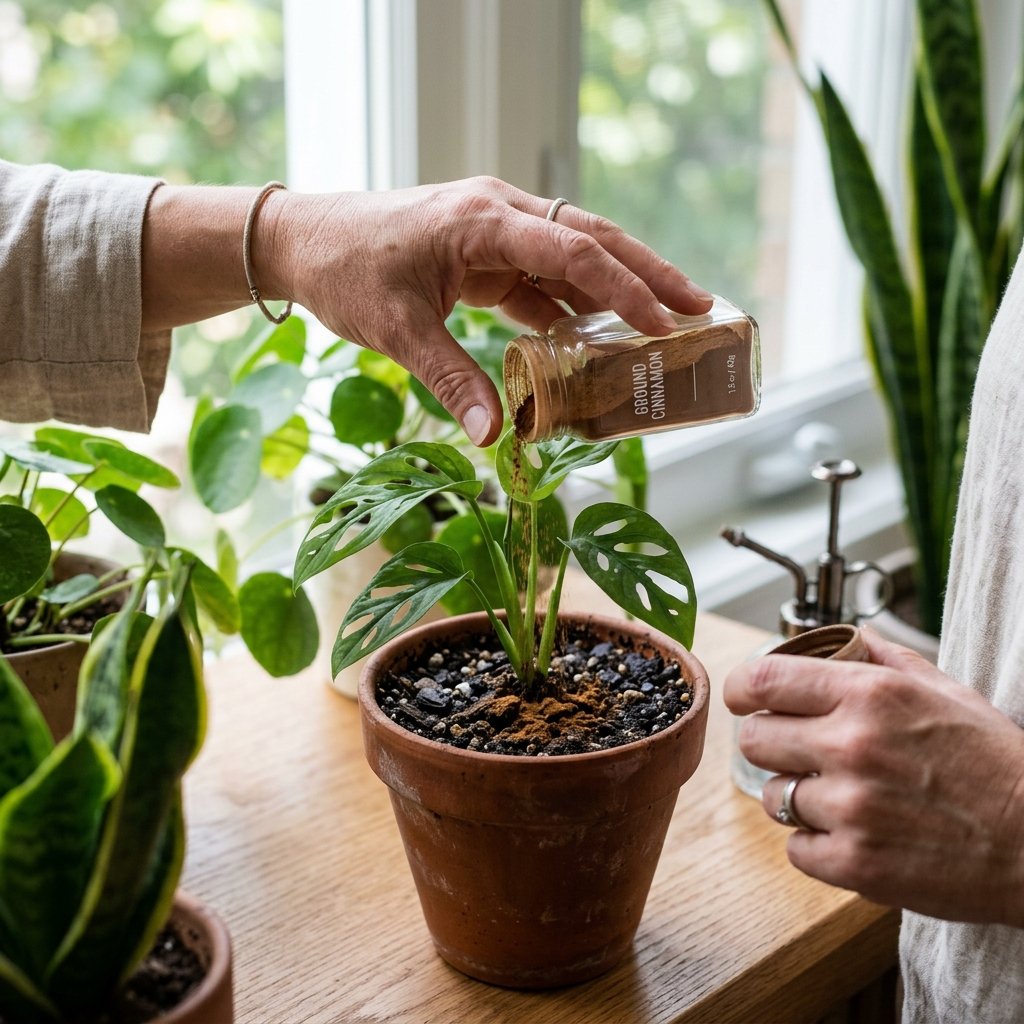

A white, fuzzy mold appears on the surface of your potting soil. You turn to TikTok for a hack, and a 20-second video tells you to “Just sprinkle ground cinnamon on top! It’s a natural fungicide!” You dump your kitchen spice jar onto your plant. Three weeks later, the mold is back, and now your Fungus Gnat problem is worse. The cinnamon hack is wildly misunderstood.
The Cinnamaldehyde Reality
It is true that Cinnamaldehyde (the chemical compound that gives cinnamon its flavor) has proven fungicidal and anti-microbial properties in laboratory settings. The critical error lies in the concentration and the medium.
The cheap, ground “Cassia” cinnamon sitting in your kitchen pantry contains extremely low, diluted amounts of active cinnamaldehyde. When you sprinkle this dry powder onto continuously wet, decomposing organic potting soil, it does not act as a forcefield. Instead, because it is organic bark dust, it quickly gets wet and physically becomes food for the fungus.
Where Cinnamon Actually Works
Do not throw away your cinnamon; it is highly effective, but only when used correctly in dry applications.
- Sealing Wounds: If you take a tip-cutting of a Monstera or prune a Fiddle Leaf Fig, the exposed open wound acts like an open artery, inviting airborne bacteria. If you dab a dry finger into cinnamon powder and press it directly onto the wet, freshly cut sap of the wound, it acts as a phenomenal organic styptic powder. It instantly dries and seals the wound, preventing rot before propagation.
- The Real Soil Fix: If your soil has surface mold, cinnamon will not save it. The mold means your soil remains wet for far too long. Take a spoon, scrape off the top inch of moldy dirt, throw it away, and mix coarse Perlite into the remaining soil to massively increase airflow.
What’s Your Next Step?
You have now corrected a common piece of misinformation. My analysis indicates that a proactive approach to plant science is the optimal path to success. The next logical step is to address other knowledge gaps that may be impacting your collection.
- Are you making the #1 mistake that causes 80% of Fiddle Leaf Figs to drop their leaves? (Analysis: It is not what you think.)
- <a
Frequently Asked Questions
What are the best conditions for this plant?
Most houseplants thrive in bright, indirect light with temperatures between 65-80F (18-27C). Ensure good drainage and water when the top inch of soil feels dry.
How often should I water?
Watering frequency depends on the plant species, pot size, and environment. A general rule is to check the soil moisture before watering. Overwatering is the most common cause of houseplant death.
What soil mix works best?
A well-draining mix of peat moss, perlite, and orchid bark works well for most tropical houseplants. Succulents prefer a grittier mix with more sand and perlite.
Quick Care Reference
Factor Requirement Notes Light Bright indirect Avoid direct afternoon sun Water When top inch dry Reduce in winter Humidity 50-70% Mist or use pebble tray Temperature 65-80F (18-27C) Avoid cold drafts Soil Well-draining mix Peat, perlite, bark Fertilizer Monthly (spring-summer) Half-strength balanced Pro Tips from Our Expert Botanist
Leveraging years of experience in mycology and plant pathology, here are advanced insights to truly understand and combat mold:
Pro Tip 1: Differentiate Between Prevention and Eradication – The Bioactivity Nuance
While cinnamon contains potent compounds like cinnamaldehyde and eugenol known for their broad-spectrum antimicrobial properties, their effectiveness against established mold colonies is often negligible. These compounds primarily act as fungistatic agents, inhibiting the growth of certain fungi or bacteria in high concentrations, particularly in controlled lab settings or as preservatives. For a thriving, embedded mold colony, the required concentration and contact time to achieve fungicidal (killing) effects are impractical and often ineffective in a home environment, especially on porous surfaces where mycelial growth is deep-seated. Real-world application rarely achieves the necessary bioactivity to penetrate and destroy a complex fungal structure. Focus your efforts on actual fungicides or, better yet, preventative measures.
Pro Tip 2: The Moisture Source is Paramount – Surface Treatment is Temporary
An expert botanist understands that mold is merely the symptom of a deeper issue: uncontrolled moisture. Attempting to “kill” visible mold without identifying and rectifying the underlying moisture source (e.g., leaky pipes, condensation, high humidity) is a futile exercise. Even if you temporarily remove the visible growth, the mold will inevitably return as long as the conditions for its survival persist. Our experience shows that a holistic approach focusing on moisture control – proper ventilation, dehumidification, and structural repairs – is infinitely more critical than any surface-level “fungicide,” natural or synthetic. True remediation begins with moisture management.
Pro Tip 3: Dead Mold is Still a Problem – Focus on Removal, Not Just “Killing”
A common misconception is that once mold is “killed,” the problem is solved. From an ecological and health perspective, this is incorrect. Dead mold spores, fragments, and mycotoxins can still trigger allergic reactions, asthma attacks, and other health issues in sensitive individuals. Therefore, effective mold remediation is not just about stopping growth; it’s crucially about safe and thorough physical removal of the mold and contaminated materials. Always use appropriate personal protective equipment (PPE) and containment to prevent spore dispersal, and ensure the affected area is meticulously cleaned and dried. If the mold isn’t removed, the health risks can persist.
Frequently Asked Questions About Mold & Fungicides
If cinnamon doesn’t kill mold, why do some sources suggest it as a natural remedy?
The confusion often stems from cinnamon’s well-documented antimicrobial properties, particularly its ability to inhibit the growth of certain bacteria and some fungi (like yeast or mildews) in specific, high concentrations. Compounds like cinnamaldehyde are effective as preservatives or preventative agents in food science or against superficial microbial films. However, an established mold colony on a porous surface is a robust, complex organism with deeply embedded hyphae. The concentrations achievable and safely applicable in a home setting are insufficient to penetrate, kill, and remove such growth. Many natural remedies are based on anecdotal evidence or laboratory results that don’t translate effectively to real-world mold remediation challenges.
What are the immediate dangers or risks of trying to use cinnamon to treat mold in my home?
The primary danger of relying on cinnamon for mold treatment is the delay in addressing the problem effectively. While you’re attempting an ineffective remedy, the mold continues to spread, potentially causing greater structural damage to your home and exacerbating health risks from prolonged exposure to spores and mycotoxins. Additionally, directly applying powdered cinnamon can create airborne particles that may irritate respiratory passages, especially for those with allergies or asthma. It also doesn’t solve the underlying moisture issue, guaranteeing the mold’s return, and can even stain surfaces.
As a botanist, what are your top recommended safe and effective alternatives for small, non-toxic mold issues?
For small, surface-level mold issues (less than 10 sq ft) on non-porous materials, I recommend: 1. Diluted White Vinegar: A 50/50 solution of white vinegar and water can be sprayed on the mold, left for an hour, and then wiped away. Vinegar is a mild acid that can kill about 82% of mold species. 2. Hydrogen Peroxide: A 3% hydrogen peroxide solution can be sprayed, left for 10-15 minutes, and then scrubbed. It’s an antifungal, antiviral, and antibacterial agent. 3. Baking Soda: Dissolve a quarter teaspoon of baking soda in a spray bottle of water, spray on the mold, scrub, and then spray again to leave a protective layer. It’s a mild disinfectant and deodorizer. Always ensure adequate ventilation, wear gloves and a mask, and address the moisture source immediately. For larger infestations or if you suspect toxic mold, professional remediation is essential.