
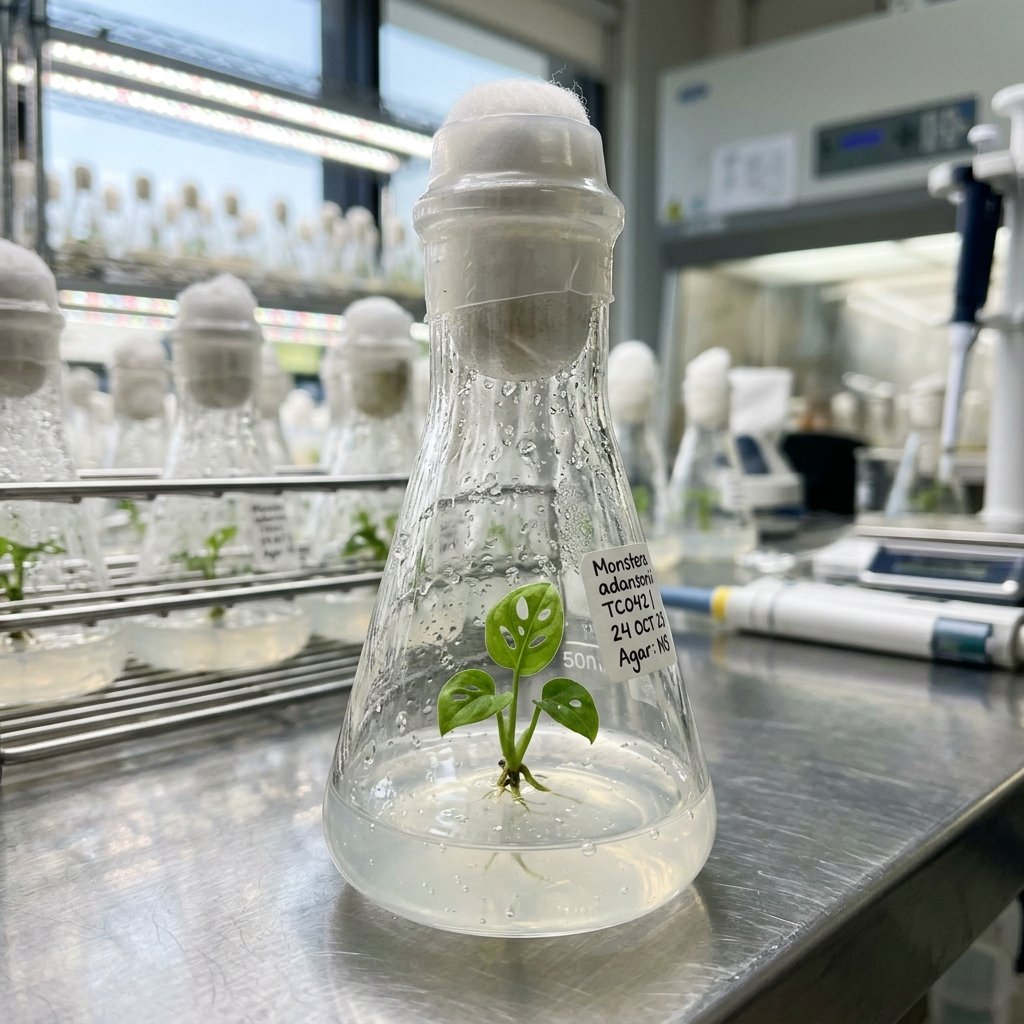

Buying a rare $500 Philodendron Spiritus Sancti as a fully grown plant is impossible for most people. Buying a tiny, microscopic baby Spiritus Sancti inside a sealed laboratory flask for $50 is highly accessible. Buying Tissue Culture (TC) flasks is the hottest trend in the hobby, but the mortality rate for beginners attempting to remove them from the flask is devastatingly high.
The Shock of the Outside World
Inside the flask, the baby plant lives in a utopia. The humidity is 100%. The air is completely sterile with zero fungal spores. The agar gel provides a constant IV drip of sugar and hormones. When you open that flask, the plant experiences the equivalent of being dropped onto Mars.
The De-Flasking Protocol
- The Agar Wash: Using lukewarm water and a soft paintbrush, you must meticulously wash every single speck of the clear agar gel off the delicate roots. If you leave a speck of agar on the plant, bacteria in the air will instantly consume the sugary gel and rot the plant.
- The Fungicide Dip: Submerge the tiny plant in a weak fungicide solution for 5 minutes. The plant has literally zero immune system; it has never encountered a pathogen before.
Building the Humidity Chamber
You cannot put a TC plant into soil immediately. Its leaves lack a thick waxy cuticle (because it didn’t need one at 100% humidity). At standard room humidity, the plant will desiccate and shrivel into a crisp in 2 hours.
Plant the baby in pure, sterilized perlite or Fluval Stratum. Place it inside a clear Tupperware container with a sealed lid to instantly recreate the 100% humidity flask environment. Over the next 4 weeks, you must slowly crack the lid of the Tupperware open, dropping the humidity by 5% every few days to force the plant to physically grow a waxy cuticle and adapt to room air.
What’s Your NextFrequently Asked Questions
What are the best conditions for this plant?
Most houseplants thrive in bright, indirect light with temperatures between 65-80F (18-27C). Ensure good drainage and water when the top inch of soil feels dry.
How often should I water?
Watering frequency depends on the plant species, pot size, and environment. A general rule is to check the soil moisture before watering. Overwatering is the most common cause of houseplant death.
What soil mix works best?
A well-draining mix of peat moss, perlite, and orchid bark works well for most tropical houseplants. Succulents prefer a grittier mix with more sand and perlite.
Quick Care Reference
What are the best conditions for this plant?
Most houseplants thrive in bright, indirect light with temperatures between 65-80F (18-27C). Ensure good drainage and water when the top inch of soil feels dry.
How often should I water?
Watering frequency depends on the plant species, pot size, and environment. A general rule is to check the soil moisture before watering. Overwatering is the most common cause of houseplant death.
What soil mix works best?
A well-draining mix of peat moss, perlite, and orchid bark works well for most tropical houseplants. Succulents prefer a grittier mix with more sand and perlite.
| Factor | Requirement | Notes |
|---|---|---|
| Light | Bright indirect | Avoid direct afternoon sun |
| Water | When top inch dry | Reduce in winter |
| Humidity | 50-70% | Mist or use pebble tray |
| Temperature | 65-80F (18-27C) | Avoid cold drafts |
| Soil | Well-draining mix | Peat, perlite, bark |
| Fertilizer | Monthly (spring-summer) | Half-strength balanced |