
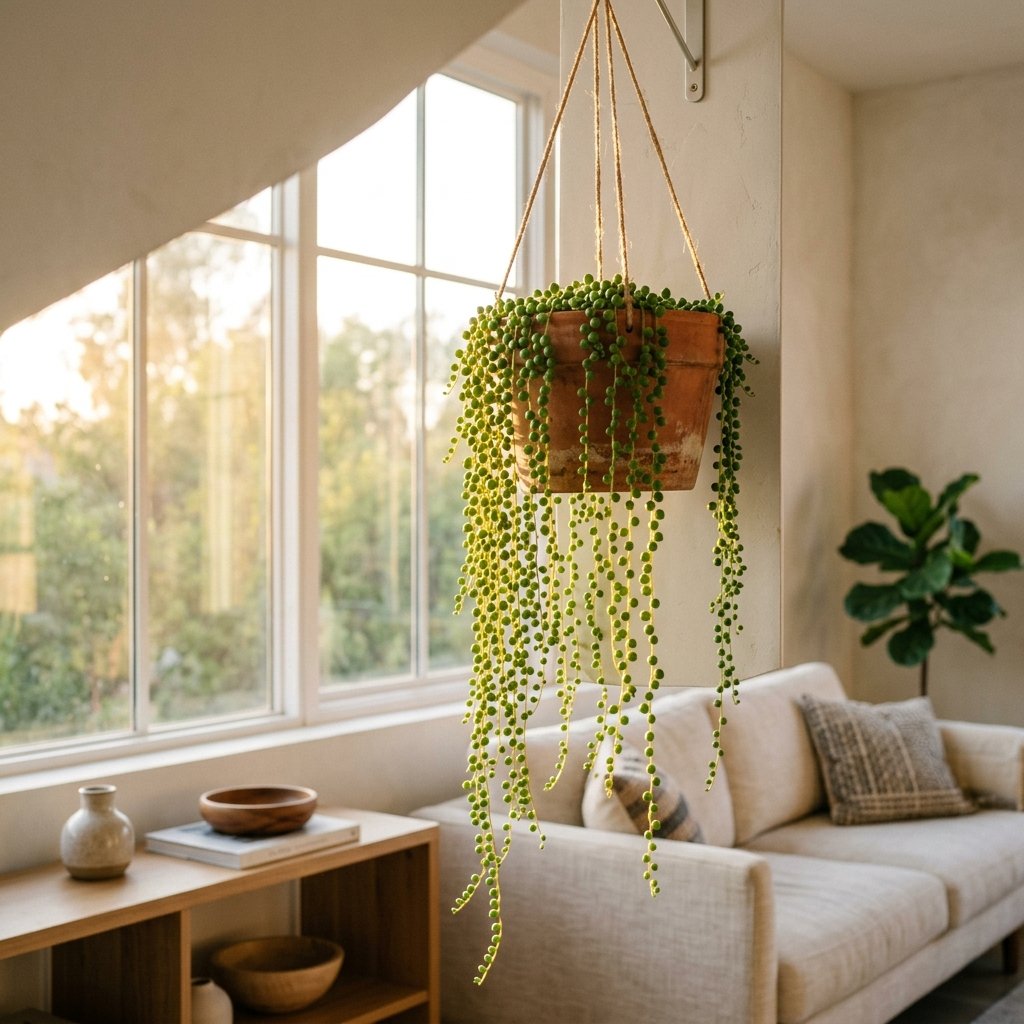

The String of Pearls (Senecio rowleyanus) is mesmerizing—cascading vines covered in perfect, spherical green beads. But it is universally considered one of the hardest succulents to keep alive indoors. People buy beautiful, full pots, and within a month, the pearls shrivel, turn to yellow mush, and the entire vine rots off at the soil line. Why does this happen?
The Anatomy of the Pearl
Those green beads are completely engorged with water. Because they are spheres, they have a massive volume-to-surface-area ratio, meaning they evaporate water incredibly slowly. They are designed to survive the brutal, arid deserts of Southwest Africa. When you water them like a tropical houseplant, they explode from the inside out.
The Two Fatal Mistakes
- The Deep Pot: String of Pearls possess incredibly shallow, weak root systems. If you plant them in a deep 6-inch pot, the bottom 4 inches of soil will stay wet for weeks, functioning as an anaerobic swamp that suffocates the shallow roots above. They must be planted in ultra-shallow bowls.
- Top-Watering the Crown: If you pour water directly on top of the pearls resting on the soil, the water gets trapped beneath those tiny spheres. At room temperature, this trapped moisture breeds bacterial rot in hours, destroying the stems before the roots even drown.
The “Empty Window” Watering Cue
Never, ever water a String of Pearls on a schedule. You must wait for the physical signs of extreme dehydration.
Look closely at a single pearl. You will see a tiny, translucent vertical stripe on the bead. This is the “epidermal window,” which allows light into the center of the sphere for photosynthesis. When the pearl is full of water, this window is wide open and the bead is perfectly round. When the plant is severely thirsty, the bead will visibly shrivel, and that translucent window will pinch closed to a tiny slit. When you see the slits close, it is finally time to heavily bottom-water the pot, keeping the pearls on top perfectly dry.
What’s Your Next Step?
Your watering protocol is now optimized. However, root rot is often a symptom of multiple environmental stressors. To ensure the long-term resilience and vitality of your Senecio rowleyanus, you must resolve these two critical variables:
- Now that you’ve saved your plant, are you ready to master the propagation technique that can turn a single healthy stem into 10+ new plants in under 6 weeks?
- <a href="https://plantsmag.com/grow-light-spectrums-part-2-the-myth-of-window-filtered-light/" style="color: #
Frequently Asked Questions
What are the best conditions for this plant?
Most houseplants thrive in bright, indirect light with temperatures between 65-80F (18-27C). Ensure good drainage and water when the top inch of soil feels dry.
How often should I water?
Watering frequency depends on the plant species, pot size, and environment. A general rule is to check the soil moisture before watering. Overwatering is the most common cause of houseplant death.
What soil mix works best?
A well-draining mix of peat moss, perlite, and orchid bark works well for most tropical houseplants. Succulents prefer a grittier mix with more sand and perlite.
Quick Care Reference
Factor Requirement Notes Light Bright indirect Avoid direct afternoon sun Water When top inch dry Reduce in winter Humidity 50-70% Mist or use pebble tray Temperature 65-80F (18-27C) Avoid cold drafts Soil Well-draining mix Peat, perlite, bark Fertilizer Monthly (spring-summer) Half-strength balanced