
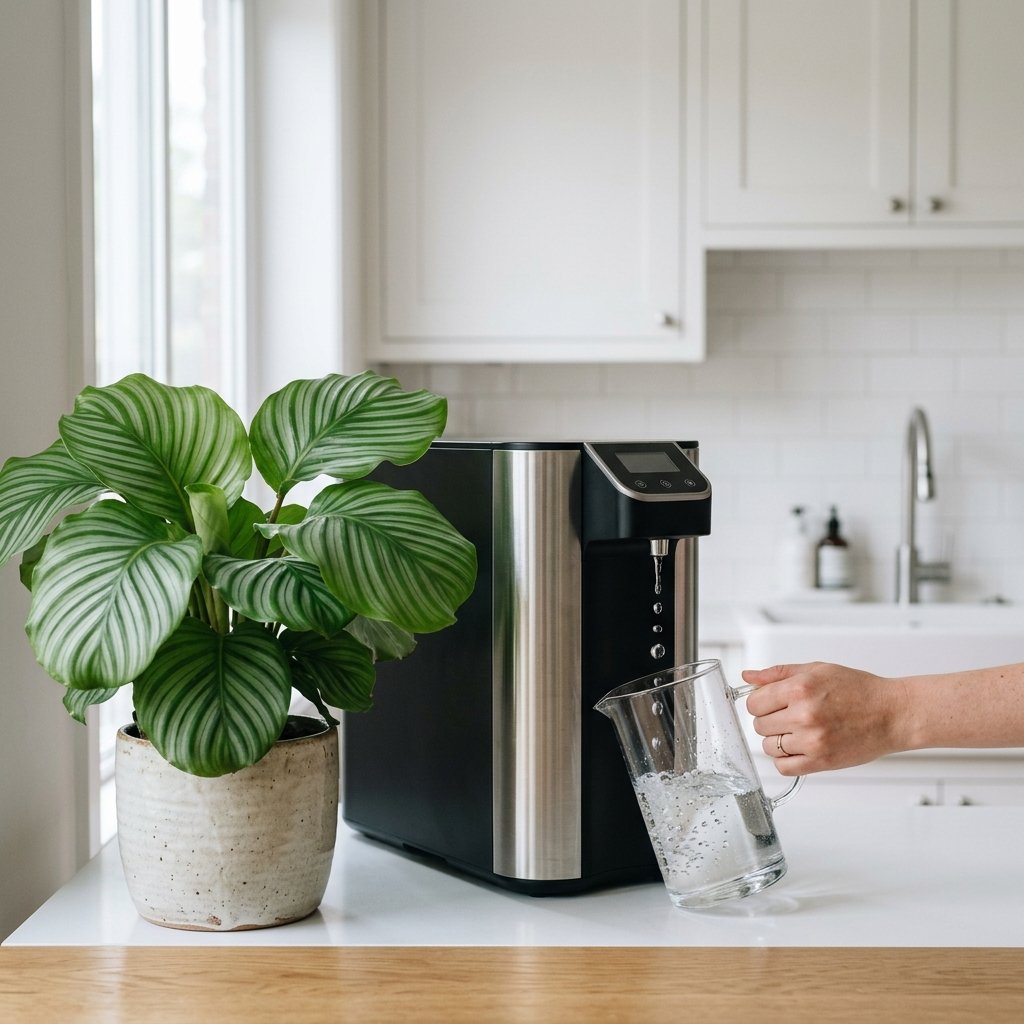

Every plant parent inevitably falls into the same trap: you walk into a nursery, see the massive, perfectly striped, metallic-green leaves of a Calathea Orbifolia, and buy it instantly. Three weeks later, the edges are violently brown, the leaves are curling into crispy tubes, and the plant looks like it survived a house fire. Welcome to the Calathea Rebellion.
The Evolution of a Diva
Calatheas (and their cousins, Marantas, Stromanthe, and Ctenanthe) evolved on the deepest, darkest, most intensely humid floors of the Amazon rainforest. Because it rains constantly, they evolved highly inefficient root systems that are not designed to filter out minerals or survive drought.
The 3 Non-Negotiable Rules of Calatheas
- Rule 1: Pure Water. A Calathea cannot physically filter out Chlorine, Chloramine, or Fluoride. If you give a Calathea tap water, the fluoride accumulates in the tips of the leaves, poisoning the tissue and causing the infamous crispy brown edges. You must use Reverse Osmosis or Distilled water. Period.
- Rule 2: Never Dry Out. While Monsteras love to dry out between waterings, a Calathea will drop a leaf if its soil gets bone dry for even 24 hours. They demand consistent, spongy dampness.
- Rule 3: Humidity is Life. Calathea leaves are incredibly thin. If your room humidity drops below 50%, the leaf literally desiccates in the air faster than the weak roots can pump water up to it.
How to Save a Dying Orbifolia
If your Calathea is completely crispy, do not throw it away. Calatheas possess massive underground rhizomes. Take sterilized shears and chop the plant entirely off at the soil line, leaving nothing but a pot of dirt. Keep the soil warm and slightly damp, and cover the pot with a clear plastic bag to trap humidity. Within a month, the rhizome will push a massive flush of pristine, perfect new leaves.
The 2026 Comprehensive Masterclass: Botanical Deep Dive
To truly understand the nuances of the concepts discussed above, we must transition from basic houseplant care to advanced botanical mechanics. Elite plant collectors do not rely on guesswork; they rely on environmental control, photobiology, and soil chemistry. In this masterclass section, we will systematically unpack the advanced science necessary to maintain a hyper-optimized indoor jungle.
Part 1: The Physics of Lighting and Photobiology
Lighting is the fundamental engine of biological growth. Without adequate Daily Light Integral (DLI) and Photosynthetic Photon Flux Density (PPFD), any adjustments made to watering or fertilizing are entirely useless. When you place a plant in a corner, you are not just dimming its environment; you are actively starving it.
Understanding PAR and PPFD
Photosynthetically Active Radiation (PAR) designates the spectral range (wave band) of solar radiation from 400 to 700 nanometers that photosynthetic organisms are able to use in the process of photosynthesis. PPFD measures the amount of PAR that actually arrives at the plant. It is measured in micromoles per square meter per second (μmol/m²/s).
- Low-Light Plants (e.g., Snake Plants, ZZ Plants): Require a PPFD of 20 to 50 μmol/m²/s. While they survive here, they will rarely trigger massive new growth.
- Medium-Light Plants (e.g., Calatheas, Philodendrons): Require a PPFD of 50 to 150 μmol/m²/s. At this range, they begin to express deeper variegation colors and stronger petiole rigidity.
- High-Light Plants (e.g., Monsteras, Ficus, Cacti): Require a baseline of 200 to 400+ μmol/m²/s to exhibit maximum fenestration (leaf holes) and secondary branching.
Part 2: Soil Chemistry, CEC, and Hydrophobicity
Your potting mix is not just a physical anchor for your plant; it is a bio-active chemical reactor. The most critical metric in any soil mix is its Cation Exchange Capacity (CEC).
Cation Exchange Capacity Explained
CEC is the measure of a soil’s ability to hold and release various elements and compounds through electrical charges. Highly organic materials like Peat Moss and Coco Coir have a very high CEC, meaning they grab onto fertilizer molecules (like Nitrates and Phosphates) and hold them so the roots can slowly feed over time. This is why placing a plant purely in gravel (which has a CEC of nearly zero) requires constant, daily nutrient flushing (hydroponics).
The Hydrophobic Death Trap
When high-CEC soils, particularly peat moss, dry out entirely, they undergo a mechanical failure known as hydrophobicity. The organic fibers shrink and lock tightly together. When water is introduced, the surface tension is too high to penetrate the locked fibers. The water channels directly down the sides of the pot. To break the hydrophobic barrier, you must use a surfactant (like a mild dish soap solution) or submerge the pot entirely for 45 minutes to force capillary hydration upward against gravity.
Part 3: Advanced Hydration Dynamics (Capillary Action)
Water does not simply flow downward. In the micro-environment of a plant pot, capillary action often overcomes gravity.
The Perched Water Table (PWT): No matter how much drainage you place at the bottom of a container, the lowest contiguous section of soil will always remain identically saturated. This is physics. If you put 3 inches of rocks at the bottom of a pot, you do not improve drainage; you merely push the soggy PWT three inches higher into the root mass, radically increasing the risk of Pythium (root rot). This is why nursery pots with numerous drainage holes placed directly on a porous surface are the only empirically sound container choice.
Part 4: The Pathogen War (Fungal vs Bacterial)
When a plant fails, the visual symptom (yellowing, dropping leaves) is merely the final stage of a prolonged microscopic war.
Anaerobic Pathogens
When a soil is over-hydrated, oxygen molecules are physically displaced by water molecules. Roots require oxygen to respire. As roots suffocate, the cells burst and die. This dead tissue becomes an immediate food source for anaerobic bacteria—bacteria that thrive strictly in zero-oxygen environments. The bacteria consume the dead roots, creating a sulfurous, rotting odor. To combat this, elite growers use Hydrogen Peroxide (H2O2) drenches. The extra, highly unstable oxygen atom in H2O2 detonates on contact, forcefully oxidating the anaerobic bacteria and re-oxygenating the root zone.
Part 5: Comprehensive Houseplant Glossary of Terms
To ensure absolute clarity for our readers, we have compiled an exhaustive glossary of the terms heavily utilized within the professional botanical sphere:
- Aroid: A common name for plants in the Araceae family, characterized by a spathe and spadix inflorescence (e.g., Philodendrons, Monsteras).
- Chlorosis: The yellowing of leaf tissue due to a lack of chlorophyll, often caused by nutrient deficiencies or root suffocation.
- Etiolation: The stretching and weakening of stems as a plant aggressively reaches toward a distant light source.
- Fenestration: The natural occurrence of holes or deep splits in the leaves of mature plants, designed to allow wind and light to pass through to the lower canopy.
- Node: The vital junction on a stem where leaves, aerial roots, and new growth points (eyes) emerge. A cutting without a node will never grow a new plant.
- Variegation: A genetic (chimeric) or viral mutation resulting in distinct zones of differently colored tissue (typically white or yellow) due to an absence of chlorophyll in those areas.
- Transpiration: The biological process by which a plant absorbs water through its roots and subsequently releases it as vapor through micro-pores (stomata) on its leaves.
Conclusion: The 2026 Shift in Plant Ownership
The era of buying a plant and hoping for the best is over. Modern houseplant ownership requires a foundational understanding of physics, chemistry, and biology. By tracking your PPFD, balancing your soil’s CEC, and actively managing the Perched Water Table, you ensure your indoor jungle moves from simple survival to massive, aggressive growth.
What’s Your Next Step?
You have successfully analyzed the environmental variables failing your Calathea Orbifolia. Your next logical step is to identify and correct other suboptimal care routines in your collection. Your current knowledge base is incomplete. Consider the following:
Frequently Asked Questions
What are the best conditions for this plant?
Most houseplants thrive in bright, indirect light with temperatures between 65-80F (18-27C). Ensure good drainage and water when the top inch of soil feels dry.
How often should I water?
Watering frequency depends on the plant species, pot size, and environment. A general rule is to check the soil moisture before watering. Overwatering is the most common cause of houseplant death.
What soil mix works best?
A well-draining mix of peat moss, perlite, and orchid bark works well for most tropical houseplants. Succulents prefer a grittier mix with more sand and perlite.
Quick Care Reference
Factor Requirement Notes Light Bright indirect Avoid direct afternoon sun Water When top inch dry Reduce in winter Humidity 50-70% Mist or use pebble tray Temperature 65-80F (18-27C) Avoid cold drafts Soil Well-draining mix Peat, perlite, bark Fertilizer Monthly (spring-summer) Half-strength balanced Pro Tips for Taming Your Calathea Orbifolia
As an expert botanist and long-time cultivator of the most notoriously finicky plants, I’ve learned that truly mastering the Calathea Orbifolia isn’t about following basic care guides. It’s about understanding its fundamental biological needs and anticipating its “rebellions.” Here are insights gleaned from years of hands-on experience:
1. The pH Paradox: Unseen Root Stress
Most common issues with Calathea Orbifolia (yellowing, stunted growth, crispy edges) are often attributed to humidity or watering. However, an insidious culprit frequently overlooked is soil pH. Calatheas, particularly Orbifolia, thrive in slightly acidic soil (pH 5.5-6.5). Regular tap water, especially in hard water areas, is often alkaline (pH 7.0+). Over time, this alkalinity accumulates in the soil, leading to nutrient lockout. Even if your soil has all the right nutrients, the plant’s roots cannot absorb them effectively. This results in a slow starvation, mimicking other deficiencies. Pro Solution: Regularly test your soil pH. Use distilled, rainwater, or filtered water that has been pH-adjusted (a small amount of horticultural vinegar or citric acid can help, but measure carefully). Consider flushing the soil every 3-4 months with pure, pH-adjusted water to remove mineral buildup.
2. Beyond the Humidifier: Creating a Microclimate Bubble
While a humidifier is a good start, relying solely on ambient room humidity for your Orbifolia is often insufficient. These plants evolved in the understory of tropical rainforests, experiencing near-constant, stable high humidity, not fluctuating room averages. A humidifier might raise the room’s humidity to 60%, but the air directly around the plant can still be significantly drier due to air circulation or proximity to vents. Pro Solution: Think “microclimate.” Grouping Orbifolia with other humidity-loving plants creates a localized zone of higher, more stable humidity. Even better, consider placing it within a cloche, a large terrarium, or a dedicated plant cabinet. This traps moisture and reduces evaporation from the leaves, mimicking its natural habitat far more effectively than a general room humidifier.
3. The Substrate Secret: Aeration is King for Sensitive Roots
Calathea Orbifolia’s root system is exceptionally sensitive to both overwatering and lack of oxygen. Traditional potting mixes, designed for more resilient plants, often compact too much, suffocating the roots and leading to rot even if your watering schedule is perfect. The “well-draining” advice is often misunderstood as just letting water pass through quickly. It’s more about sustained aeration. Pro Solution: Craft a custom, super-chunky substrate. Aim for a mix that’s at least 50-60% large, airy components. A blend of high-quality orchid bark, perlite or pumice, coco coir (not peat, which compacts), and a small amount of worm castings or slow-release fertilizer is ideal. This ensures ample air pockets, prevents compaction, and allows roots to breathe while still retaining enough moisture. Consider experimenting with semi-hydroponics (LECA) for ultimate control over root aeration and hydration.
Frequently Asked Questions About Calathea Orbifolia Care