
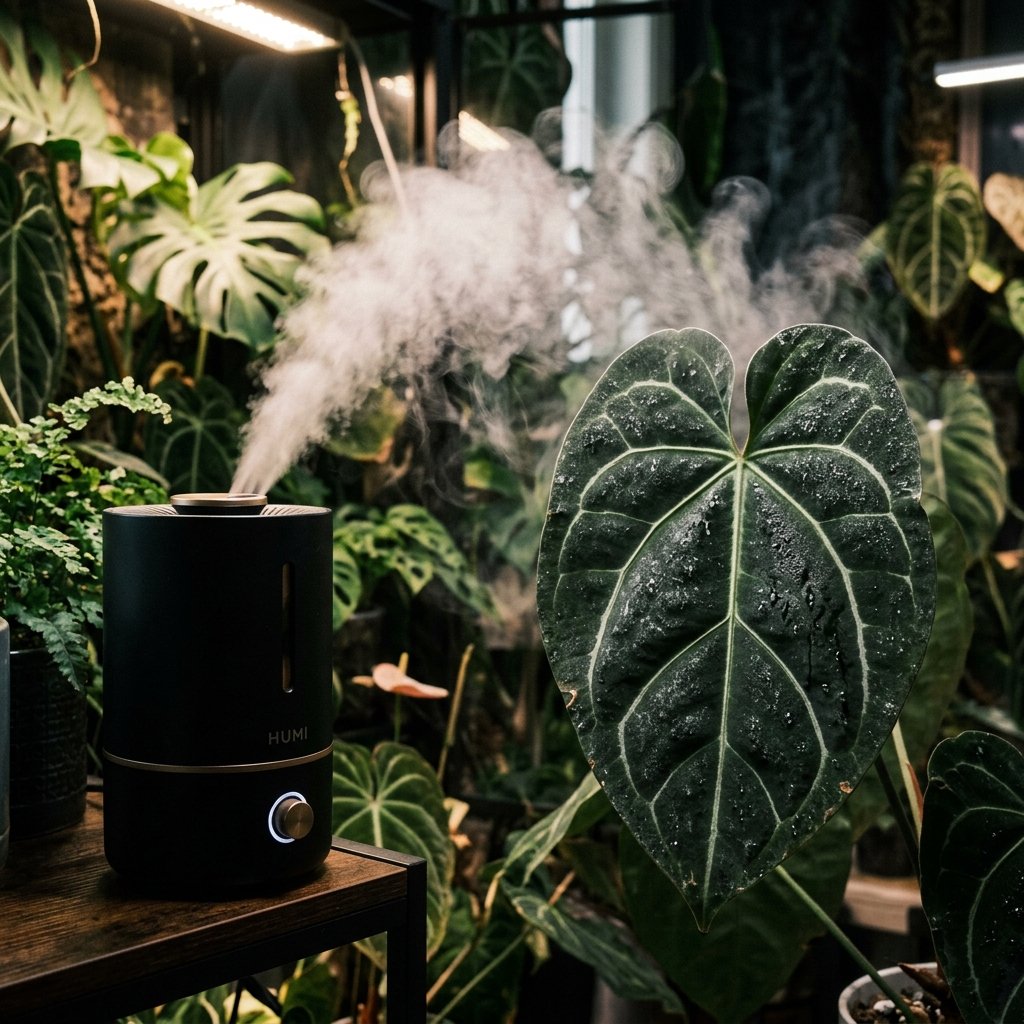

To keep calatheas lush and anthuriums velvety, we run humidifiers. We pump gallons of mist into our living rooms every single day trying to mimic the jungles of Ecuador. But this obsession with 80% relative humidity is creating a massive secondary crisis in the houseplant community: Toxic White Dust and Black Mold.
The White Dust Phenomenon
Have you noticed a fine, chalky white powder settling on your TV screen, your furniture, and most importantly, the leaves of your plants? This is caused by using tap water in an Ultrasonic Humidifier.
Ultrasonic humidifiers use a vibrating metal diaphragm to shatter water droplets into a fine mist. Unlike boiling steam humidifiers, ultrasonics aerosolize EVERYTHING in the water. If your tap water contains calcium, magnesium, and heavy metals, the humidifier blasts those minerals directly into the air. When the water evaporates, the minerals fall as toxic white dust, clogging your plant’s stomata (pores) and suffocating them.
How to Fix It
- Switch to Distilled/RO Water: Using pure, 0 PPM water eliminates white dust instantly.
- Switch to Evaporative Humidifiers: These use a wicking filter and a fan. The heavy minerals are trapped in the filter, and only pure, invisible H2O vapor enters the air.
The Hidden Threat: Black Mold
Pushing a room’s humidity to 75% creates a perfect breeding ground for Stachybotrys (black mold) inside your drywall, around your window sills, and directly on the top layer of your houseplant soil.
The Golden Equation: Humidity + Airflow
High humidity without aggressive airflow equals guaranteed fungal disaster. If you run a humidifier, you MUST run oscillating circulation fans in the room 24/7. Air movement prevents condensation from forming on walls and plant leaves, starving mold spores of the liquid water they need to germinate.
Humidifier Maintenance Warning
The pink sludge that builds up in the base of your humidifier? That is Serratia marcescens, an airborne bacterium that can cause severe respiratory infections in humans and pets. Your humidifier tank must be sterilized with white vinegar or a weak bleach solution once a week. You are aerosolizing whatever grows in that tank directly into your lungs.
What’s Your Next Step?
You have now optimized your environment for human health. The next logical step is to analyze how this same environment affects your high-value biological assets. Your actions have consequences.
<ul style='list-style-
Frequently Asked Questions
What are the best conditions for this plant?
Most houseplants thrive in bright, indirect light with temperatures between 65-80F (18-27C). Ensure good drainage and water when the top inch of soil feels dry.
How often should I water?
Watering frequency depends on the plant species, pot size, and environment. A general rule is to check the soil moisture before watering. Overwatering is the most common cause of houseplant death.
What soil mix works best?
A well-draining mix of peat moss, perlite, and orchid bark works well for most tropical houseplants. Succulents prefer a grittier mix with more sand and perlite.
Quick Care Reference
| Factor | Requirement | Notes |
|---|---|---|
| Light | Bright indirect | Avoid direct afternoon sun |
| Water | When top inch dry | Reduce in winter |
| Humidity | 50-70% | Mist or use pebble tray |
| Temperature | 65-80F (18-27C) | Avoid cold drafts |
| Soil | Well-draining mix | Peat, perlite, bark |
| Fertilizer | Monthly (spring-summer) | Half-strength balanced |