
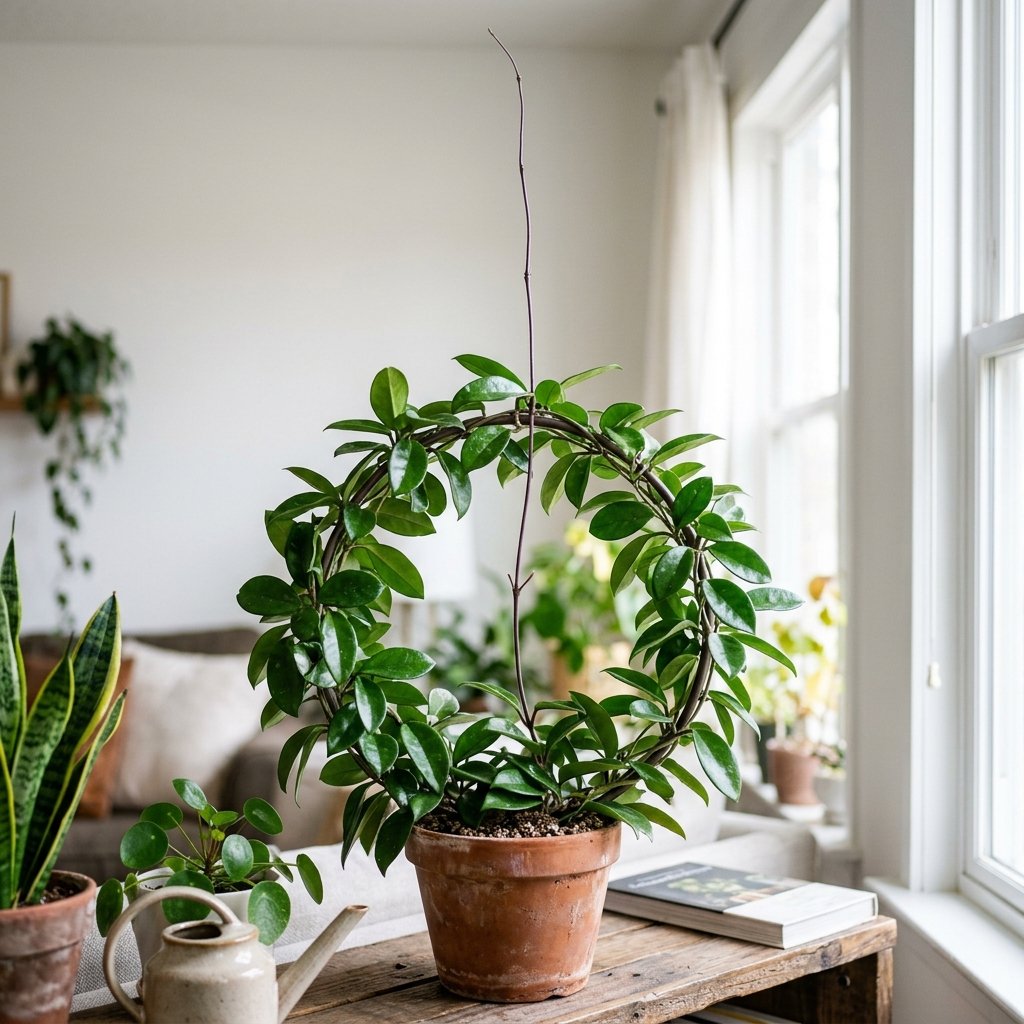

You have a beautiful Hoya Carnosa or Hoya Pubicalyx. Suddenly, it pushes out a massive, rapidly growing vine that shoots three feet straight up into the air. However, there is a major problem: the vine is completely bare. There is not a single leaf on it. Frustrated by this ugly “blind vine,” you snip it off. You just made the biggest mistake in Hoya care.
The Search Protocol of Epiphytes
Hoyas are climbing epiphytes in the wild. That long, bare, leafless vine isn’t a mistake; it is a highly evolved sensor. The plant is throwing out a “feeler” vine, desperately whipping it around in a circle to find a tree branch to anchor onto.
The plant intentionally refuses to grow leaves on this sensory vine because leaves are heavy and cost energy. It will only invest the energy into growing foliage once the vine confirms it has successfully anchored to a stable, vertical structure.
The Immediate Fix: The Circle Trellis
- Never cut the blind vine. If you cut it, the Hoya will simply waste energy growing another blind vine to replace it.
- Instead, insert a circular wire or bamboo trellis firmly into the pot.
- Gently take the long, bare vine, and physically wrap it tightly around the trellis. Secure it with a soft orchid clip. Be incredibly careful not to snap the brittle tip.
The Leaf Explosion
The moment you physically wrap and secure the vine, the Hoya registers mechanical resistance. It believes it has successfully climbed a tree. Within 14 days, that entirely naked vine will miraculously activate every single dormant node along its length, rapidly pushing out a massive flush of perfect, waxy new leaves simultaneously. Give your Hoyas something to grab, and they will reward you instantly.
What’s Your Next Step?
- <a href="https://plantsmag.com/the
Frequently Asked Questions
What are the best conditions for this plant?
Most houseplants thrive in bright, indirect light with temperatures between 65-80F (18-27C). Ensure good drainage and water when the top inch of soil feels dry.
How often should I water?
Watering frequency depends on the plant species, pot size, and environment. A general rule is to check the soil moisture before watering. Overwatering is the most common cause of houseplant death.
What soil mix works best?
A well-draining mix of peat moss, perlite, and orchid bark works well for most tropical houseplants. Succulents prefer a grittier mix with more sand and perlite.
Quick Care Reference
Factor Requirement Notes Light Bright indirect Avoid direct afternoon sun Water When top inch dry Reduce in winter Humidity 50-70% Mist or use pebble tray Temperature 65-80F (18-27C) Avoid cold drafts Soil Well-draining mix Peat, perlite, bark Fertilizer Monthly (spring-summer) Half-strength balanced Pro Tips from an Expert Botanist (2026 Guide)
Beyond the basics of trellising, experienced Hoya growers understand that preventing the “Blind Vine” phenomenon requires a deeper, more nuanced approach. Here are 2-3 highly advanced, experience-based insights to elevate your Hoya trellis technique:
1. Substrate-Root Synergy for Optimal Energy Allocation
The health and composition of your Hoya’s root system, directly influenced by your substrate, are paramount. Blind vines often signal a plant dedicating energy to exploratory growth rather than reproductive effort. An optimal substrate (e.g., chunky aroid mix, semi-hydroponics, or a very airy orchid bark blend) ensures superior root aeration and nutrient uptake efficiency. This allows the plant to allocate energy more effectively towards developing robust leaves and, crucially, flower peduncles. Focus on a substrate that provides consistent moisture without waterlogging, promoting a dense, healthy root ball that can support a thriving, floriferous vine, not just an elongating one.
2. Preemptive Training & Apical Dominance Management
Don’t wait for blind vines to appear. Implement preemptive training from a young age. As new vines emerge, gently guide and secure them to the trellis early on. More importantly, understand and manage apical dominance. The primary growing tip (apex) often inhibits lateral bud development. Strategic, light tip-pruning on overly long or stubborn blind vines can break this dominance, encouraging the plant to branch out and activate dormant nodes along the vine. These new lateral growths are often more vigorous and prone to developing leaves and flowers, transforming a bare vine into a lush, productive section of your Hoya.
3. Environmental Triggers & Hormonal Balance for Floral Initiation
While light intensity is crucial, consider the subtle environmental triggers that influence a Hoya’s internal hormonal balance towards flowering. Experienced growers observe that slight, consistent temperature differentials (e.g., a 5-10°F drop at night compared to day), coupled with specific light spectrums (richer in red and blue wavelengths, often found in full-spectrum grow lights), can signal to the plant that conditions are ripe for reproduction. Furthermore, adjusting nutrient ratios (slightly higher phosphorus and potassium during active growth periods) can encourage bud formation over purely vegetative elongation. Understanding these nuanced triggers helps shift the plant’s energy from producing blind vines to initiating the much-desired flower peduncles.
Frequently Asked Questions About Hoya Blind Vines
- What exactly is the “Blind Vine” Phenomenon in Hoya?
- The “Blind Vine” phenomenon in Hoya refers to a specific growth habit where a vine elongates significantly without developing leaves or flower peduncles along its length. These vines often appear bare, thin, and are primarily focused on seeking out support or better light conditions. While a natural exploratory growth phase, prolonged blind vine development is undesirable as it diverts the plant’s energy from producing foliage and, crucially, flowers, leading to a less aesthetically pleasing and unproductive plant. It’s a sign the plant is expending energy on growth without productive output in terms of leaves or blooms.
- How does trellising specifically help prevent blind vines?
- Trellising plays a crucial role in mitigating blind vine development by providing immediate and stable physical support for the Hoya’s climbing tendrils. When a Hoya vine finds a secure anchor, it signals to the plant that its exploratory phase can shift. This encourages the redirection of energy from rapid, searching growth (blind vines) towards more productive development: forming new leaves, strengthening existing stems, and initiating flower peduncles. Trellising also ensures optimal light exposure for the entire vine by positioning it effectively, a key factor in promoting robust growth and flowering, rather than just elongation in search of light or support.
- Are there specific Hoya species more prone to developing blind vines, even with trellising?
- Yes, certain Hoya species, particularly those with strong vining and climbing tendencies, can be more prone to producing blind vines even when trellised. Examples often include vigorous growers like *Hoya carnosa* cultivars, *Hoya pubicalyx*, *Hoya obovata*, and some of the faster-growing species that rapidly put out long runners. For these varieties, diligent and early training onto the trellis, combined with strategic pruning to encourage lateral branching and breaking apical dominance, becomes even more critical. Environmental factors such as insufficient light, inconsistent watering, or nutrient deficiencies can exacerbate this tendency across many Hoya types, but some species have a stronger genetic predisposition.