
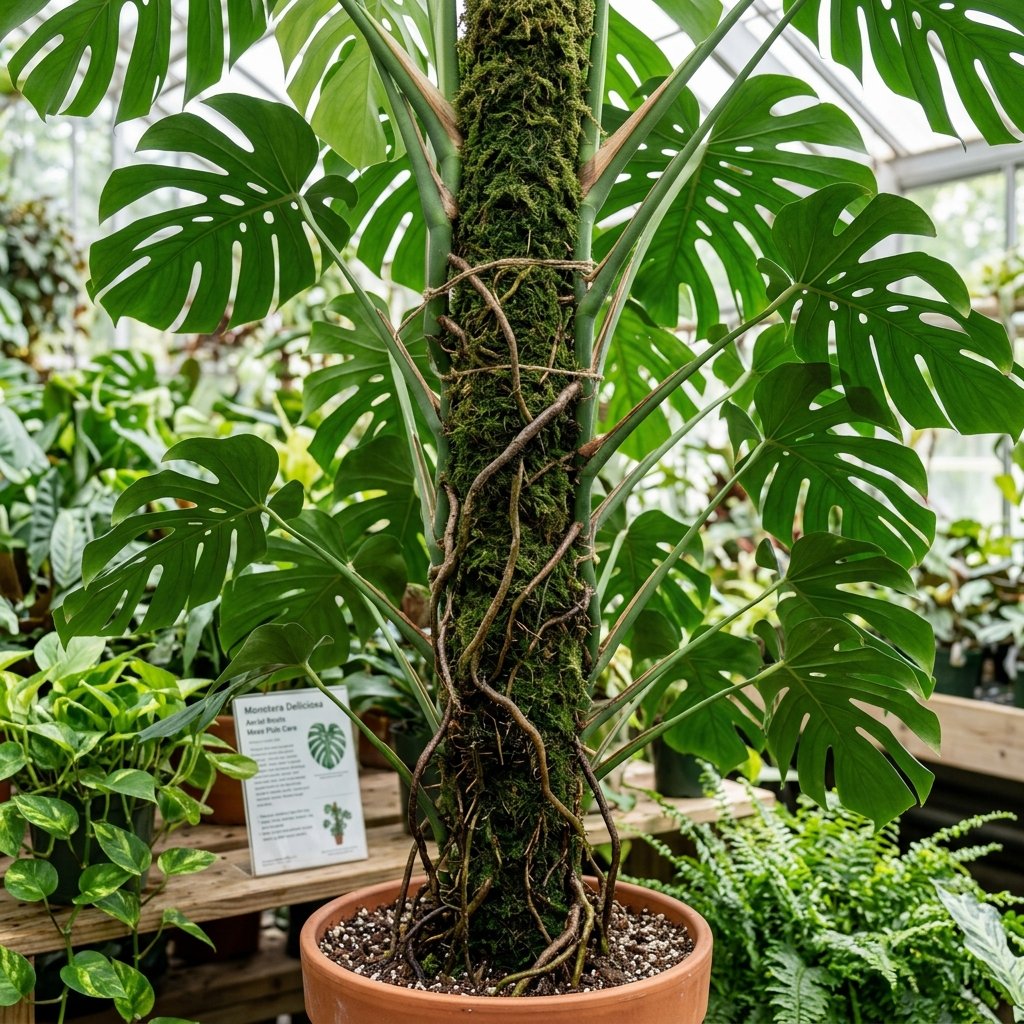

Your Monstera Deliciosa was cute and bushy when you bought it, but now it is a sprawling, chaotic mess of vines crawling horizontally across your living room floor. To get massive, fenestrated (holy) leaves, the plant must climb vertically. But which support system actually works?
The Coir Pole: A Useless Stick
90% of “moss poles” sold on Amazon are not moss. They are made of Coco Coir (coconut fiber) wrapped around a PVC pipe. Coir is incredibly hydrophobic—it violently repels water. When you spray a coir pole, the water drips straight off. Because it is bone dry, the aerial roots of your Monstera will merely wrap *around* it like a snake, but they will never root *into* it. It is nothing more than a structural stick.
The Real Sphagnum Moss Pole
A true moss pole is a D-shaped plastic or wire mesh cylinder stuffed tightly with high-grade, long-strand Chilean Sphagnum Moss. Sphagnum moss acts like a hyper-absorbent sponge.
- The Magic: Because the moss stays wet for days, the Monstera’s aerial roots literally push through the mesh and grow deep into the core of the pole. The pole becomes an extension of the pot.
- The Result: When the plant realizes it has a secondary, vertical water source, it activates maturity hormones. This is how you force a Monstera to produce massive, double-fenestrated leaves.
The Wooden Trellis
A standard wooden trellis or bamboo ladder is cheap and beautiful, but it provides zero moisture. It acts exactly like a Coir pole. It is excellent for light vining plants like Pothos or Philodendron Micans, but it will never unlock the true mature leaf size of a heavy Aroid.
Frequently Asked Questions
What are the best conditions for this plant?
Most houseplants thrive in bright, indirect light with temperatures between 65-80F (18-27C). Ensure good drainage and water when the top inch of soil feels dry.
How often should I water?
Watering frequency depends on the plant species, pot size, and environment. A general rule is to check the soil moisture before watering. Overwatering is the most common cause of houseplant death.
What soil mix works best?
A well-draining mix of peat moss, perlite, and orchid bark works well for most tropical houseplants. Succulents prefer a grittier mix with more sand and perlite.
Quick Care Reference
| Factor | Requirement | Notes |
|---|---|---|
| Light | Bright indirect | Avoid direct afternoon sun |
| Water | When top inch dry | Reduce in winter |
| Humidity | 50-70% | Mist or use pebble tray |
| Temperature | 65-80F (18-27C) | Avoid cold drafts |
| Soil | Well-draining mix | Peat, perlite, bark |
| Fertilizer | Monthly (spring-summer) | Half-strength balanced |