
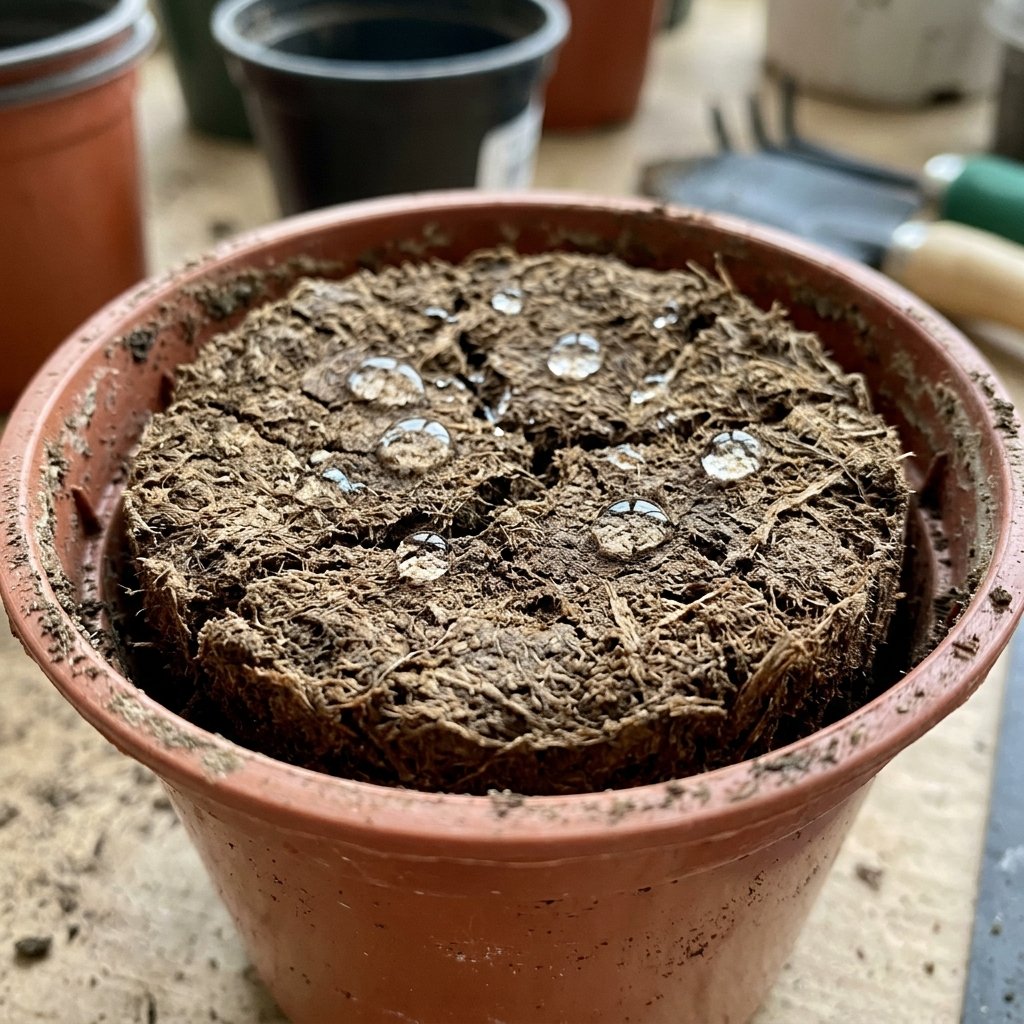

You buy a premium bag of “Indoor Potting Mix” from a big-box store. For the first few months, your plants thrive. But suddenly, when you water the plant, the water pools on top of the soil for five minutes before finally vanishing. When you poke the soil, it feels like a solid brick of concrete. Why did your expensive soil turn into a rock?
The Danger of 100% Peat
Almost all commercial potting soils are based heavily on Peat Moss. Peat moss is fantastic at holding moisture when it is already damp. However, it suffers from a fatal flaw: when peat moss dries out completely, it becomes aggressively hydrophobic (water-repellent). The microscopic organic fibers shrink and lock together tightly, forming an impenetrable brick that shrinks away from the sides of the pot.
How to Break the Brick
If you top-water a peat brick, the water simply flows down the cracks along the side of the pot and out the bottom. Your plant effectively dies of thirst while sitting in “wet” soil.
- The Emergency Fix: You must force the peat moss to rehydrate using intense capillary action. Submerge the entire pot in a bowl of warm water (warm water breaks surface tension faster than cold water) for at least 45 minutes. Read our comprehensive guide on Bottom Watering vs Top Watering for the exact science.
- The Permanent Fix: Never use straight potting soil. Always mix 40% coarse Perlite and 20% Orchid Bark into your potting soil before planting. This creates permanent “air pockets” that physically prevent the peat from locking together when it dries.
Frequently Asked Questions
What are the best conditions for this plant?
Most houseplants thrive in bright, indirect light with temperatures between 65-80F (18-27C). Ensure good drainage and water when the top inch of soil feels dry.
How often should I water?
Watering frequency depends on the plant species, pot size, and environment. A general rule is to check the soil moisture before watering. Overwatering is the most common cause of houseplant death.
What soil mix works best?
A well-draining mix of peat moss, perlite, and orchid bark works well for most tropical houseplants. Succulents prefer a grittier mix with more sand and perlite.
Quick Care Reference
| Factor | Requirement | Notes |
|---|---|---|
| Light | Bright indirect | Avoid direct afternoon sun |
| Water | When top inch dry | Reduce in winter |
| Humidity | 50-70% | Mist or use pebble tray |
| Temperature | 65-80F (18-27C) | Avoid cold drafts |
| Soil | Well-draining mix | Peat, perlite, bark |
| Fertilizer | Monthly (spring-summer) | Half-strength balanced |