
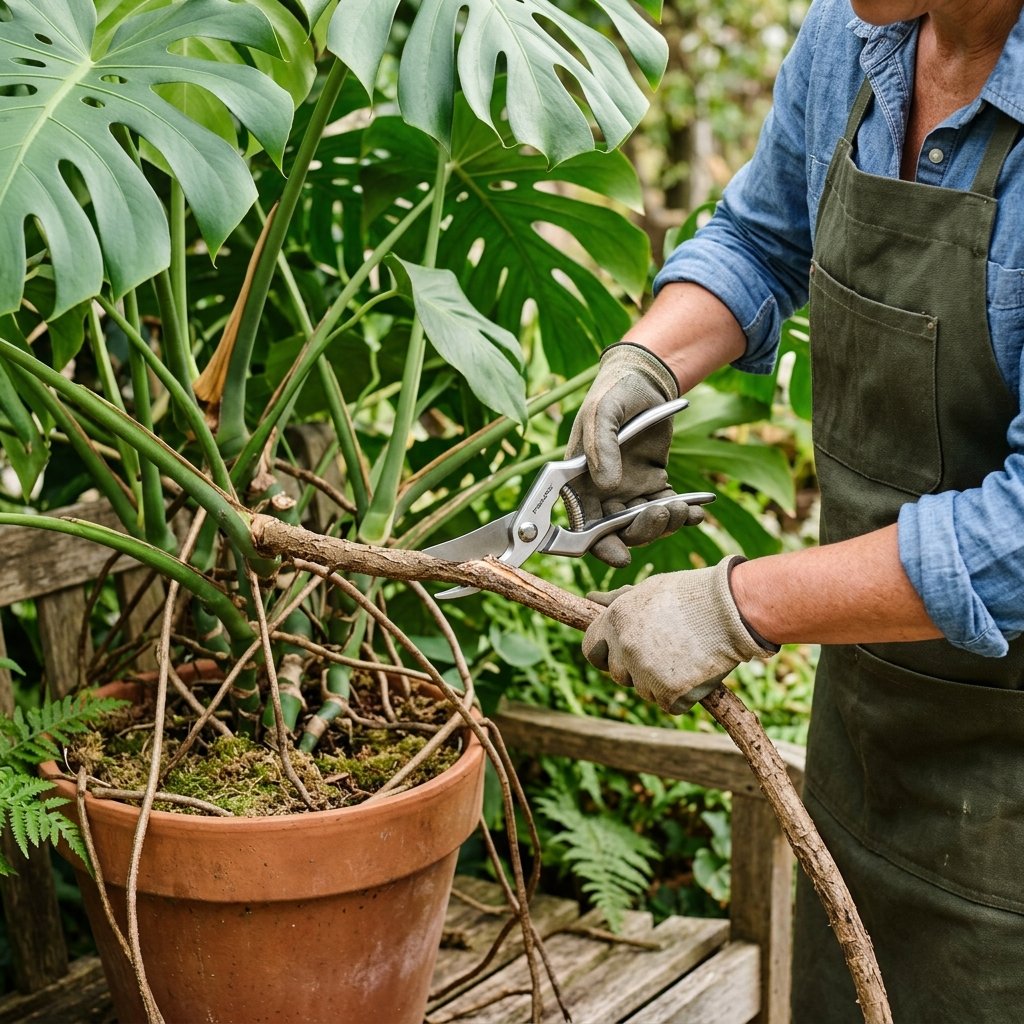

For most people, the Golden Pothos is a beautiful, trailing vine that cascades delicately off a bookshelf with leaves the size of a tea cup. But did you know that the Pothos is biologically capable of producing colossal, 3-foot-wide leaves with massive fenestrations (splits) that rival a Monstera Deliciosa? The secret is entirely mechanical.
The Trailing Trap
In the wild, Pothos (Epipremnum aureum) are vines that start life on the forest floor. When a vine is trailing down toward the ground, the plant registers that it is moving further away from the sun. Biologically, the plant goes into “survival mode.” It intentionally produces smaller, weaker leaves with massive distances between the nodes, trying to conserve energy while searching blindly for a tree to climb.
The Moss Pole Trigger
If you want massive leaves, you must stop the vine from hanging and force it to climb vertically up a moist surface (like a Sphagnum moss pole).
- When the vine climbs UP, the plant registers that it is ascending a tree toward the forest canopy and the sun.
- When the aerial roots physically embed themselves into the wet moss pole, they transform into subterranean feeder roots, creating a massive secondary plumbing system to pump water directly into the upper leaves.
The Maturation Process
Once the Pothos is securely rooted into a vertical pole and fed heavy nitrogen, morphological changes occur rapidly. Within three to four new leaves, the stem will quadruple in thickness. The leaves will double in size. Eventually, the plant will trigger its adult phase, slicing its own leaves into massive fenestrations to let light pass through to the lower canopy. You cannot fertilize your way to giant leaves; you must manipulate the plant’s physical orientation.
Frequently Asked Questions
What are the best conditions for this plant?
Most houseplants thrive in bright, indirect light with temperatures between 65-80F (18-27C). Ensure good drainage and water when the top inch of soil feels dry.
How often should I water?
Watering frequency depends on the plant species, pot size, and environment. A general rule is to check the soil moisture before watering. Overwatering is the most common cause of houseplant death.
What soil mix works best?
A well-draining mix of peat moss, perlite, and orchid bark works well for most tropical houseplants. Succulents prefer a grittier mix with more sand and perlite.
Quick Care Reference
| Factor | Requirement | Notes |
|---|---|---|
| Light | Bright indirect | Avoid direct afternoon sun |
| Water | When top inch dry | Reduce in winter |
| Humidity | 50-70% | Mist or use pebble tray |
| Temperature | 65-80F (18-27C) | Avoid cold drafts |
| Soil | Well-draining mix | Peat, perlite, bark |
| Fertilizer | Monthly (spring-summer) | Half-strength balanced |