
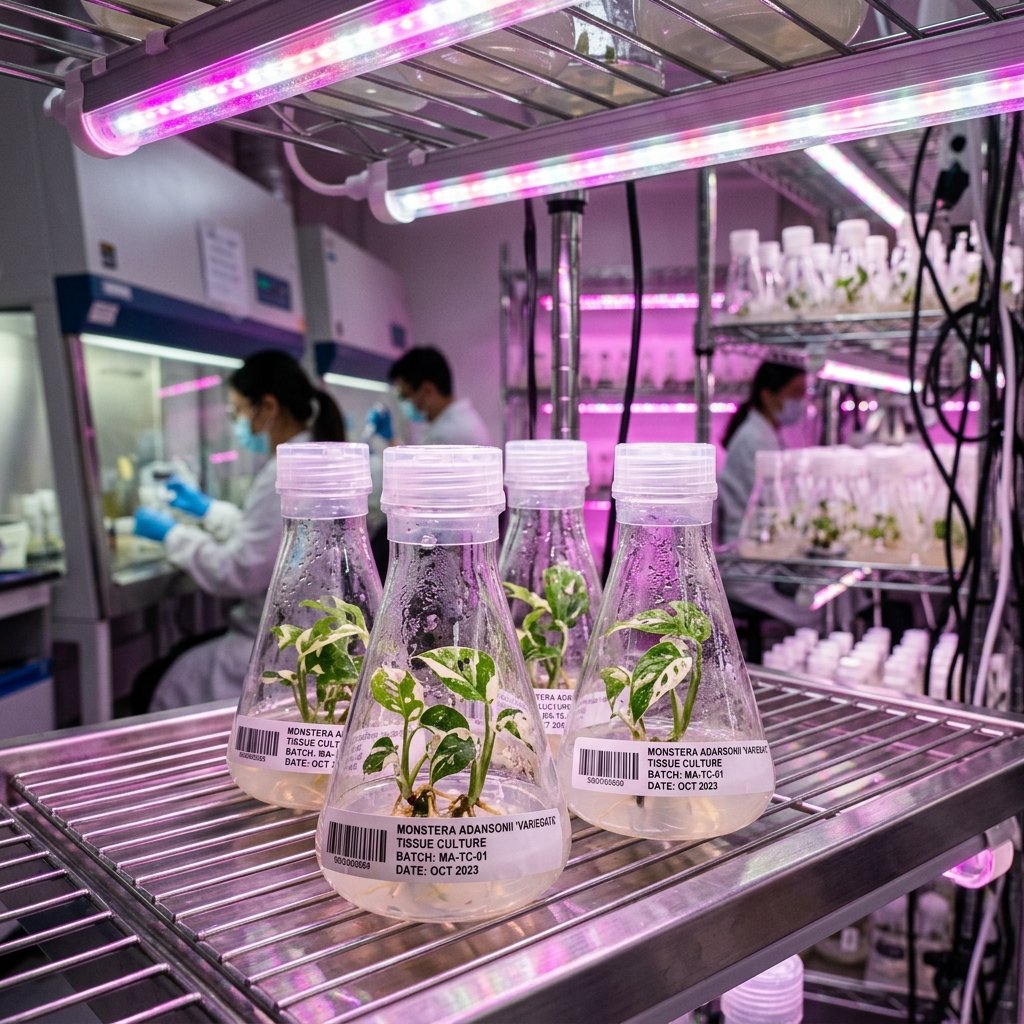

Remember when a single cutting of a Monstera Thai Constellation or Albo Borsigiana would set you back hundreds, if not thousands, of dollars? Over the last 18 months, those prices have plummeted by nearly 80%. The culprit? Tissue Culture (Micropropagation). The rapid industrialization of plant cloning has completely revolutionized the houseplant economy.
The Science of Tissue Culture (TC)
Tissue culture is the process of cloning a plant using tiny fragments of its cellular tissue—sometimes just a few cells from a meristem (node). These cells are sterilized and placed in a nutrient-rich agar jelly laced with specific plant hormones (auxins and cytokinins) inside a sterile lab environment.
Why It Changed Everything
- Mass Scale: A single mother plant can produce tens of thousands of exact genetic clones in a matter of months.
- Disease-Free: Because the tissue is sterilized, TC plants start their life completely free of pests and viruses.
- Price Parity: What used to be a luxury collector’s item is now accessible in big-box stores.
What This Means for Collectors and Growers
The “crash” of the rare plant market is only a crash if you were looking at plants as financial investments. For the average hobbyist, this is the golden era of indoor gardening. You can now curate a breathtaking, exotic jungle on a modest budget.
The Risks of Buying TC Plantlets
While the prices are tempting, many sellers are now offering plants straight out of the agar flask. Deflasking and acclimating a TC plantlet requires surgical precision. These baby plants have never experienced fluctuating humidity, unfiltered light, or non-sterile environments.
How to Successfully Acclimate a TC Monstera
- Step 1: The Rinse. Carefully wash away 100% of the agar jelly from the roots using lukewarm water. Agar is pure sugar; leaving any behind will trigger an immediate fungal explosion.
- Step 2: The Fungicide Dip. Soak the plantlet in a mild fungicide solution for 5 minutes to protect its vulnerable immune system.
- Step 3: The Humidity Dome. Plant it in a sterile substrate (like pure sphagnum moss or perlite) and place it inside a sealed humidity dome at 99% humidity.
- Step 4: Hardening Off. Over the course of 4 weeks, gradually open the vents on the dome to introduce normal room air.
Looking Forward
As tissue culture technology becomes more accessible, we are seeing hobbyists setting up “kitchen laboratories” using pressure cookers as autoclaves. The democratization of rare agroids is here, and it is beautifully chaotic.
What’s Your Next Step?
You have successfully analyzed the market shift caused by tissue culture. Your next action determines whether you capitalize on this knowledge or fall behind. Choose your path:
- Are you certain the #1 “miracle cure”
Frequently Asked Questions
What are the best conditions for this plant?
Most houseplants thrive in bright, indirect light with temperatures between 65-80F (18-27C). Ensure good drainage and water when the top inch of soil feels dry.
How often should I water?
Watering frequency depends on the plant species, pot size, and environment. A general rule is to check the soil moisture before watering. Overwatering is the most common cause of houseplant death.
What soil mix works best?
A well-draining mix of peat moss, perlite, and orchid bark works well for most tropical houseplants. Succulents prefer a grittier mix with more sand and perlite.
Quick Care Reference
Factor Requirement Notes Light Bright indirect Avoid direct afternoon sun Water When top inch dry Reduce in winter Humidity 50-70% Mist or use pebble tray Temperature 65-80F (18-27C) Avoid cold drafts Soil Well-draining mix Peat, perlite, bark Fertilizer Monthly (spring-summer) Half-strength balanced