
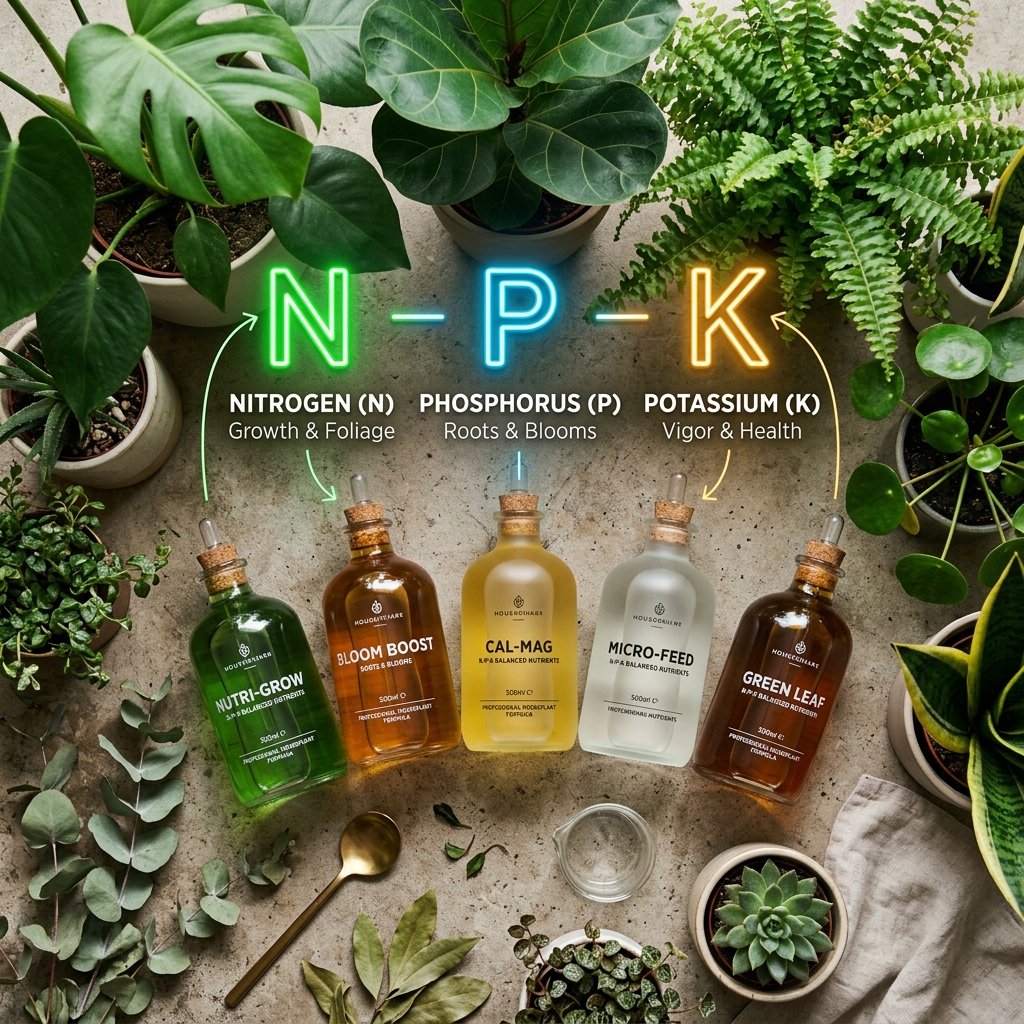

Walk down the fertilizer aisle and you will be bombarded with neon bottles claiming to be “Monstera Magic” or “Ficus Food,” branded with confusing numbers like 10-15-10 or 3-1-2. The houseplant nutrient market relies heavily on marketing intimidation. If you want to grow massive plants, you need to ignore the branding and read the N-P-K.
What Does N-P-K Actually Mean?
Those three numbers printed on every bottle legally represent the percentage by weight of Nitrogen (N), Phosphorus (P), and Potassium (K) inside the bottle.
The Holy Trinity of Plant Biology
- Nitrogen (N): The Engine. Fuels explosive vegetative growth. Responsible for the dark green color and massive leaf sizing.
- Phosphorus (P): The Generator. Drives root development and spectacular flowering/fruiting.
- Potassium (K): The Immune System. Controls the stomata, water regulation, and thickens the cellular walls of the stems.
The Perfect Houseplant Ratio
Most beginners buy “Bloom Booster” fertilizers (like 10-30-10) thinking bigger numbers mean bigger plants. This is a fatal mistake for tropical foliage plants.
A houseplant like a Philodendron or Pothos does not bloom in captivity. It only produces green leaves. The biological demand for a foliage plant is heavily skewed toward Nitrogen. The gold standard ratio scientifically proven to support tropical aroids is the 3-1-2 ratio (meaning 3 parts nitrogen, 1 part phosphorus, 2 parts potassium).
Popular premium liquid fertilizers like Foliage Pro (9-3-6) perfectly match this 3-1-2 ratio.
Organic vs. Synthetic
Are chemical fertilizers bad? Not necessarily. The plant cannot tell the difference between a nitrogen ion synthesized in a lab and a nitrogen ion processed from worm castings. The difference is the delivery method.
Synthetic Fertilizers
Synthetics are instantly bio-available. The second they touch the roots, they are absorbed. This creates rapid, explosive growth but carries a high risk of fertilizer burn if over-applied.
Organic Fertilizers
Organics (like fish emulsion or bat guano) cannot be absorbed directly. They must first be digested by microbes and bacteria in the soil, which then excrete the elemental NPK. This creates a slow, steady, burn-proof feed but requires a living, highly active soil biome to function.
Conclusion
Stop buying “Monstera specific” fertilizers. Turn the bottle around, find the NPK numbers, ensure the Nitrogen is the highest number on the label, and feed weakly, weekly.
<div class='pm-retention-hook' style='background-color: #f8fafc; border-left: 4px solid #2A7B4C; padding: 20
Frequently Asked Questions
What are the best conditions for this plant?
Most houseplants thrive in bright, indirect light with temperatures between 65-80F (18-27C). Ensure good drainage and water when the top inch of soil feels dry.
How often should I water?
Watering frequency depends on the plant species, pot size, and environment. A general rule is to check the soil moisture before watering. Overwatering is the most common cause of houseplant death.
What soil mix works best?
A well-draining mix of peat moss, perlite, and orchid bark works well for most tropical houseplants. Succulents prefer a grittier mix with more sand and perlite.
Quick Care Reference
| Factor | Requirement | Notes |
|---|---|---|
| Light | Bright indirect | Avoid direct afternoon sun |
| Water | When top inch dry | Reduce in winter |
| Humidity | 50-70% | Mist or use pebble tray |
| Temperature | 65-80F (18-27C) | Avoid cold drafts |
| Soil | Well-draining mix | Peat, perlite, bark |
| Fertilizer | Monthly (spring-summer) | Half-strength balanced |