
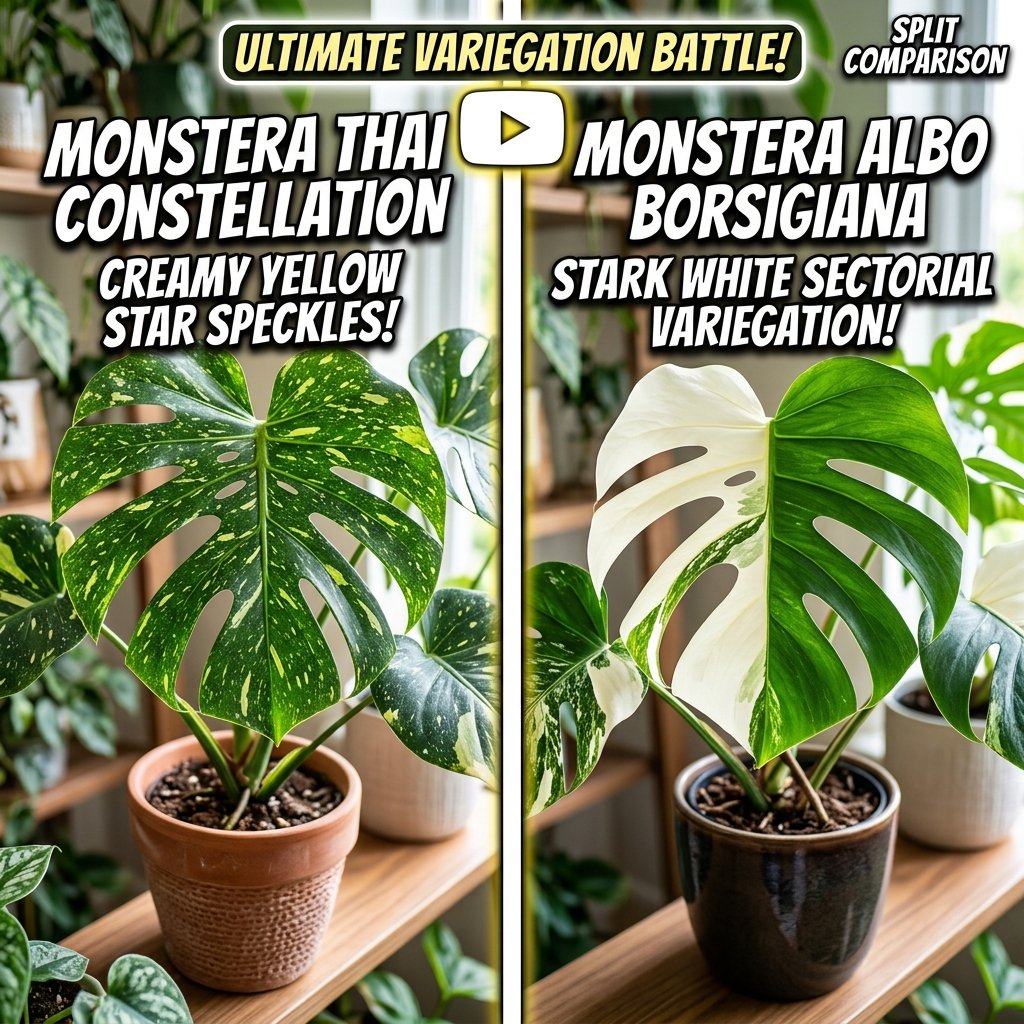

If you are spending $100 to $500 on a variegated Monstera, you must understand exactly what you are paying for. The untrained eye sees two plants with white spots. The botanical reality is that the Monstera Albo Borsigiana and the Monstera Thai Constellation are completely different organisms with fundamentally different DNA structures.
The Monstera Albo (The Gamble)
The Monstera Albo features stark, brilliant white sectorial variegation (massive blocks of pure white). However, the Albo is a Chimeric Mutation.
- The Genetics: The mutation is unstable. The plant has two distinct sets of DNA competing at the stem.
- The Risk: An Albo can randomly push fully green leaves (reverting) or fully white leaves (ghosting, which leads to starvation). You MUST prune an Albo constantly to force it to maintain its variegation.
- The White Tissue: Because the white is so pure and lacks any chlorophyll, it burns and browns incredibly easily if humidity drops below 60%.
The Monstera Thai Constellation (The Investment)
The Thai Constellation was genetically engineered in a tissue-culture laboratory in Thailand. Its variegation is characterized by creamy yellow speckles resembling a galaxy of stars.
- The Genetics: The mutation is locked into the actual DNA of every single cell. It is mathematically impossible for a Thai Constellation to “revert” to solid green. Every leaf will be variegated forever.
- The Hardiness: Because the variegation is creamy/yellow, it retains a tiny fraction of chlorophyll, making the leaves highly resistant to browning.
Which One Should You Buy?
If you want the thrill of high-contrast, dramatic white half-moon leaves and are willing to meticulously monitor stems, prune nodes, and maintain high humidity, buy the Albo. If you want a zero-stress, guaranteed variegated plant that grows massively without any intervention, the Thai Constellation is the undisputed champion.
<div class='pm-retention-hook' style='background-color: #f8fafc; border-left: 4px solid #2A7B4C; padding: 20px; margin-top:
Frequently Asked Questions
What are the best conditions for this plant?
Most houseplants thrive in bright, indirect light with temperatures between 65-80F (18-27C). Ensure good drainage and water when the top inch of soil feels dry.
How often should I water?
Watering frequency depends on the plant species, pot size, and environment. A general rule is to check the soil moisture before watering. Overwatering is the most common cause of houseplant death.
What soil mix works best?
A well-draining mix of peat moss, perlite, and orchid bark works well for most tropical houseplants. Succulents prefer a grittier mix with more sand and perlite.
Quick Care Reference
| Factor | Requirement | Notes |
|---|---|---|
| Light | Bright indirect | Avoid direct afternoon sun |
| Water | When top inch dry | Reduce in winter |
| Humidity | 50-70% | Mist or use pebble tray |
| Temperature | 65-80F (18-27C) | Avoid cold drafts |
| Soil | Well-draining mix | Peat, perlite, bark |
| Fertilizer | Monthly (spring-summer) | Half-strength balanced |