
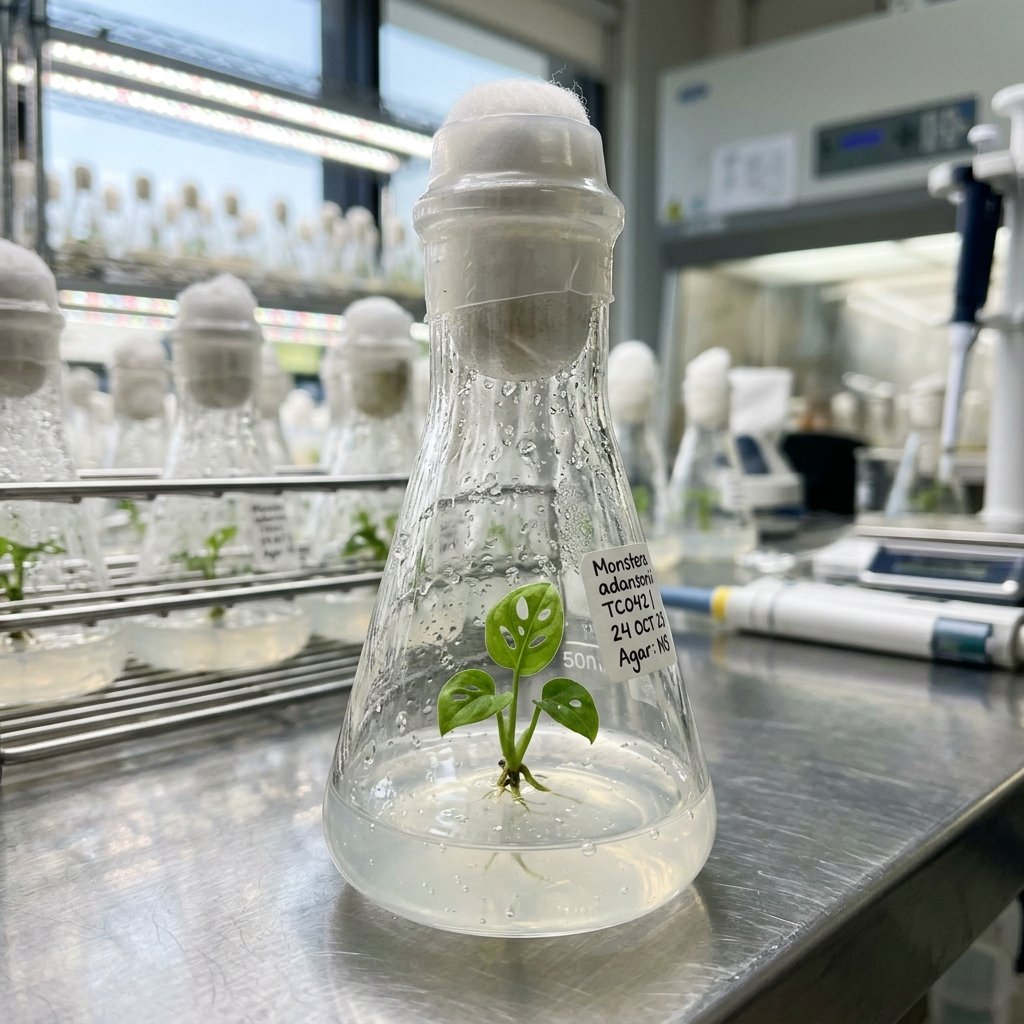

For the last five years, if you wanted a Monstera Albo Borsigiana, you had to roll the dice. You bought a single mid-cut node for $200 from a random seller online, put it in moss, and prayed it wouldn’t rot. That era is officially ending. The Tissue Culture (TC) laboratories have finally cracked the code for stable, lab-grown Monstera Albos, and it is going to crash the market.
Why It Took So Long
Labs successfully mass-produced the Thai Constellation years ago because its variegation is stable and uniform across its genetics. The Albo is chimeric—it relies on highly unstable mutations in the stem. When labs initially tried to clone Albo cells in agar flasks, 95% of the clones emerged entirely green (reverted) or entirely white (ghosts). It was totally unprofitable.
The Meristem Breakthrough
Recently, specialized labs have perfected the art of isolating cells directly from the meristem (the absolute center of the growth point) that contain the exact perfect ratio of mutant white DNA to green DNA. By culturing these specific cells in highly controlled hormonal agar, they have stabilized the cloning process.
What This Means for the Hobby
We are currently seeing the first waves of “TC Albos” hitting the wholesale markets. Unlike a traditional cutting that has to battle transplant shock and rot, TC plants emerge from the flask with fully developed, robust root systems and perfect genetics.
Over the next two years, the price of a Monstera Albo will plummet to the price of a standard grocery store plant. While this terrifies “investors” who hoarded nodes as financial assets, it is a massive victory for pure hobbyists who just want a beautiful, white-splashed plant to look at without going into credit card debt.
<div class='pm-retention-hook' style='background-color: #f8fafc
Frequently Asked Questions
What are the best conditions for this plant?
Most houseplants thrive in bright, indirect light with temperatures between 65-80F (18-27C). Ensure good drainage and water when the top inch of soil feels dry.
How often should I water?
Watering frequency depends on the plant species, pot size, and environment. A general rule is to check the soil moisture before watering. Overwatering is the most common cause of houseplant death.
What soil mix works best?
A well-draining mix of peat moss, perlite, and orchid bark works well for most tropical houseplants. Succulents prefer a grittier mix with more sand and perlite.
Quick Care Reference
| Factor | Requirement | Notes |
|---|---|---|
| Light | Bright indirect | Avoid direct afternoon sun |
| Water | When top inch dry | Reduce in winter |
| Humidity | 50-70% | Mist or use pebble tray |
| Temperature | 65-80F (18-27C) | Avoid cold drafts |
| Soil | Well-draining mix | Peat, perlite, bark |
| Fertilizer | Monthly (spring-summer) | Half-strength balanced |