
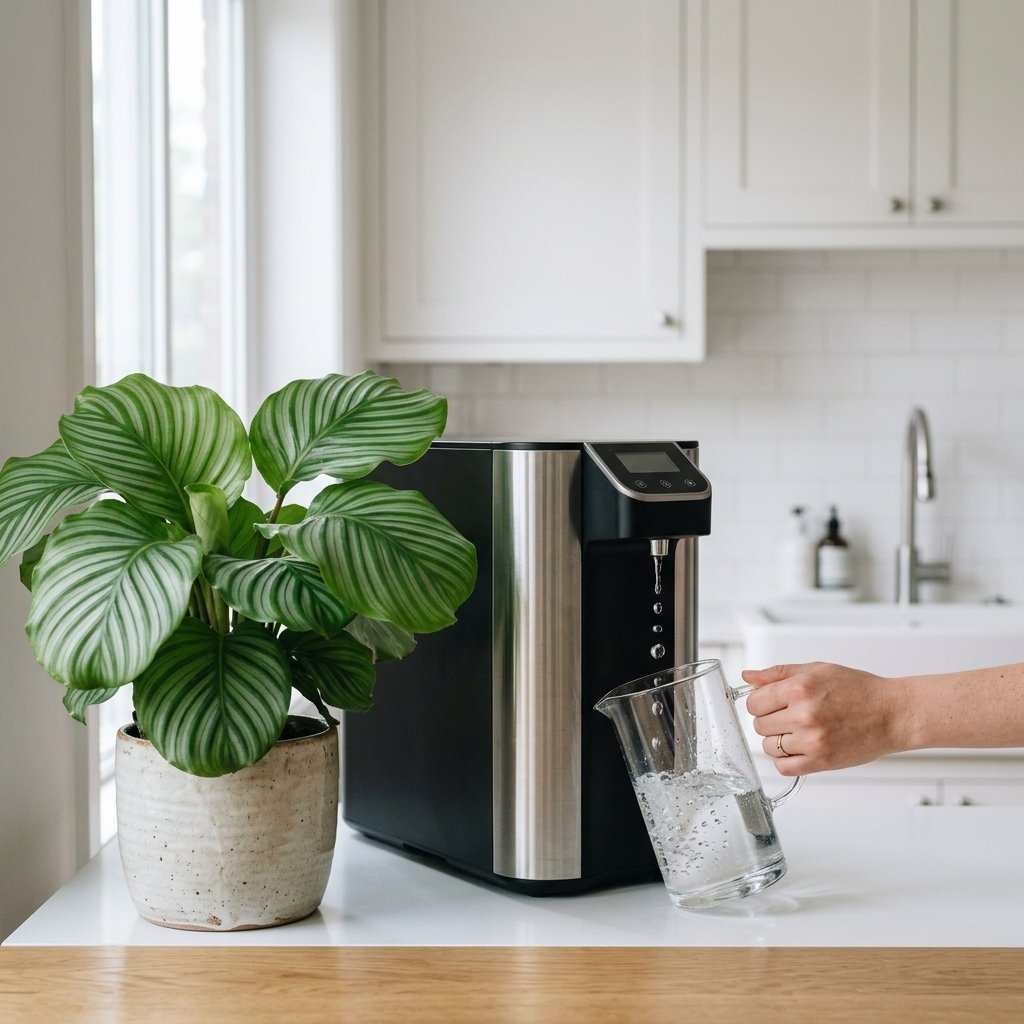

You bought a stunning $100 Calathea White Fusion. You placed it beside a humidifier. You gave it perfect, dappled light. Yet, two weeks later, its edges are turning crispy, brown, and necrotic. You are doing everything right—except the chemistry. Welcome to the hidden world of Houseplant Water Toxicity.
The Municipal Tap Water Problem
City tap water is highly engineered to be perfectly safe for humans, but it is heavily fortified with chemicals designed to kill bacteria and protect pipes. To a sensitive tropical epiphyte, taking a drink of municipal tap water is like drinking pool water.
The Big Three Toxins
- Chloramine: Unlike normal chlorine, chloramine does NOT evaporate if you leave water out overnight. It stays trapped, slowly burning sensitive root hairs.
- Fluoride: The absolute killer of Marantas, Calatheas, and Dracaenas. Fluoride accumulates in the tips of the leaves, causing the infamous “crispy brown tips” that no amount of humidity can fix.
- Calcium/Magnesium (Hard Water): Continual watering with hard water causes mineral salt buildup in the soil, raising the pH to toxic alkaline levels.
The Solution: Reverse Osmosis (RO) Systems
For years, collectors hauled gallons of distilled water from the grocery store. Today, under-sink Reverse Osmosis (RO) systems are the industry standard for high-end collectors. An RO membrane forces tap water through microscopic pores, stripping out 99.9% of all minerals, chemicals, and heavy metals. The result is pure, blank-slate H2O.
The Art of Remineralization
Watering with pure RO water is fantastic for flushing salts, but it contains zero nutritional value. If you strictly use RO water long-term, your plants will suffer calcium and magnesium deficiencies.
- Step 1: The Blank Slate. Collect your pure RO water.
- Step 2: The Cal-Mag Buffer. You must add a liquid Calcium-Magnesium supplement back into the water. This provides the essential structural building blocks for strong stems.
- Step 3: The Nutrients. Add your preferred hydroponic or organic liquid fertilizer. Because you started with RO water, there are no chaotic chemical reactions between municipal hard water and your fertilizer. You are in total control.
Which Plants ACTUALLY Need Pure Water?
While Pothos and Snake Plants are invincible and will happily drink hard tap water, the following genera absolutely demand RO or Distilled water if you want pristine, blemish-free leaves: Calathea, Maranta, Stromanthe, Ctenanthe, carnivorous plants, and rare Velvet Anthuriums.
<div class='pm-retention-hook' style='background-color: #f8fafc; border-left: 4px solid
Frequently Asked Questions
What are the best conditions for this plant?
Most houseplants thrive in bright, indirect light with temperatures between 65-80F (18-27C). Ensure good drainage and water when the top inch of soil feels dry.
How often should I water?
Watering frequency depends on the plant species, pot size, and environment. A general rule is to check the soil moisture before watering. Overwatering is the most common cause of houseplant death.
What soil mix works best?
A well-draining mix of peat moss, perlite, and orchid bark works well for most tropical houseplants. Succulents prefer a grittier mix with more sand and perlite.
Quick Care Reference
| Factor | Requirement | Notes |
|---|---|---|
| Light | Bright indirect | Avoid direct afternoon sun |
| Water | When top inch dry | Reduce in winter |
| Humidity | 50-70% | Mist or use pebble tray |
| Temperature | 65-80F (18-27C) | Avoid cold drafts |
| Soil | Well-draining mix | Peat, perlite, bark |
| Fertilizer | Monthly (spring-summer) | Half-strength balanced |